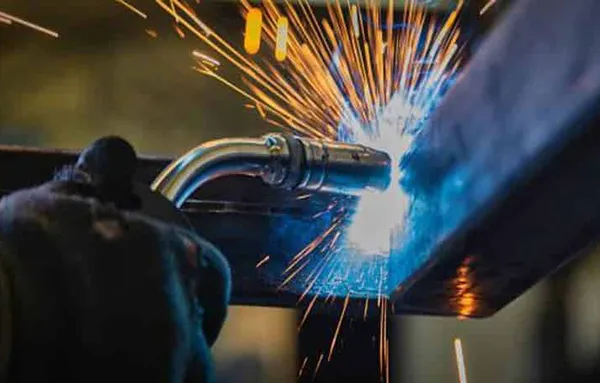

ENiFe-2 is a nickel-iron-chromium alloy covered electrode designed for welding nickel-chromium-iron alloys, 9% nickel steel, and a wide range of dissimilar metal joints. The nominal composition of the weld metal is 70Ni-15Cr-8Fe-2Mn-2Nb+Ta-2Mo, which provides excellent crack resistance, good thermal stability, and superior performance across a broad temperature range from cryogenic to approximately 980°C (1800°F).
The low-hydrogen coating ensures smooth arc characteristics, low spatter, and stable welding performance, enabling consistent weld quality in demanding industrial applications.
ENiFe-2 is widely used in LNG storage tanks and liquefied nitrogen storage tanks, cryogenic 9% nickel steel welding, dissimilar metal joints between carbon steel, stainless steel, nickel, and nickel-base alloys, as well as heat-resistant steel castings with limited weldability. It is also used for overlaying and repair welding of cast iron components such as gray cast iron, ductile cast iron, and alloy cast iron molds and dies.
ENiFe-2
| Standard | Classification |
|---|---|
| AWS A5.11 | ENiFe-2 |
| ASME II, Part C, SFA-5.11 | ENiFe-2 (UNS W86133) |
| EN ISO 14172 | E Ni 6133 |
| GB/T 13814 | ENi6133 |
Custom specifications available upon request.
| Element | C | Mn | Fe | Si | Ni | Mo | Cr | Nb+Ta | Cu | S | P |
|---|---|---|---|---|---|---|---|---|---|---|---|
| Content (%) | ≤ 0.10 | 1.0–3.5 | ≤ 12.0 | ≤ 0.75 | ≥ 62.0 | 0.5–2.5 | 13.0–17.0 | 0.5–3.0 | ≤ 0.50 | ≤ 0.020 | ≤ 0.030 |
| Property | AWS Standard (min.) | Typical Value |
|---|---|---|
| Tensile Strength, MPa (ksi) | ≥ 550 (80) | ≥ 650 (94) |
| Yield Strength (0.2% offset), MPa | ≥ 360 | ≥ 420 |
| Elongation, % | ≥ 27 | ≥ 30‑42 |
Typical values are for reference only. Actual mechanical properties may vary depending on welding parameters, joint design, and base material condition.
Ø Excellent resistance to hot cracking due to molybdenum and niobium additions, which refine weld microstructure
Ø Low-hydrogen coating minimizes hydrogen-induced cracking in high-strength steels and thick sections
Ø Stable performance across cryogenic and elevated temperature service from -196°C to approximately 980°C (1800°F)
Ø Good oxidation resistance up to approximately 820°C; above this temperature, strength and oxidation resistance significantly decrease
Ø Excellent weldability with nickel alloys, stainless steels, carbon steels, and cast iron in dissimilar metal welding applications
Ø Stable arc characteristics with low spatter and easy slag removal
Ø Good machinability of weld deposit for post-weld finishing
| Category | Details |
| Nickel Alloys | Inconel® 600 (UNS N06600), Inconel® 601, Incoloy® 800 / 800H / 800HT |
|
Cryogenic Steels |
9% nickel steel (ASTM A353, A553) for LNG storage tanks and cryogenic service |
| Dissimilar Metal Joints |
Carbon steel to stainless steel, carbon steel to nickel alloys, stainless steel to nickel alloys, and austenitic to ferritic transitions (dissimilar welding applications) |
| Cast Iron Repair | Gray cast iron, ductile cast iron, malleable cast iron, alloy cast iron molds and dies |
| Industrial Applications | LNG storage tanks and cryogenic equipment, pressure vessels, chemical reactors, heat exchangers, marine and offshore engineering, overlay and repair welding applications |
Polarity: Direct Current, Electrode Positive (DCEP / DC reverse polarity)
| Electrode Diameter | Current Range (Amperes) |
|---|---|
| 2.5 mm | 50–70 |
| 3.2 mm | 70–100 |
| 4.0 mm | 100–140 |
Ø Use a short arc length to minimize porosity and ensure stable arc performance
Ø For 9% nickel steel welding, maintain strict surface cleanliness to prevent embrittlement
Ø For dissimilar welding applications, reduce dilution by controlling travel speed and heat input
Ø For cast iron repair, control interpass temperature and consider post-weld peening to reduce stress
Diameter options:
Packaging:
Ø Reliable production quality meeting AWS A5.11 and ASME SFA-5.11 standards
Ø Strict quality control for nickel alloy welding electrodes
Ø Stable arc performance for 9% nickel steel and dissimilar welding applications
Ø Global export experience with on-time delivery
Ø Technical support for welding procedure qualification
1. Can ENiFe-2 be used for 9% nickel steel welding?
Yes, ENiFe-2 is widely used for 9% nickel steel welding in LNG storage tanks and cryogenic applications due to its excellent low-temperature toughness.
2. What is ENiFe-2 used for in dissimilar metal welding?
ENiFe-2 is commonly used for dissimilar welding applications such as carbon steel to stainless steel, stainless steel to nickel alloys, and transition joints in industrial equipment.
3. Is ENiFe-2 suitable for cryogenic service?
Yes, it performs reliably in cryogenic environments down to -196°C, making it suitable for LNG and liquefied gas systems.
4. Can ENiFe-2 be used for cast iron repair welding?
Yes, it is suitable for gray cast iron, ductile cast iron, and alloy cast iron repair, especially when higher strength is required.
5. What is the difference between ENiFe-1 and ENiFe-2 electrodes?
ENiFe-2 offers higher strength and better crack resistance due to Nb and Mo additions, making it more suitable for demanding cryogenic and dissimilar welding applications.
6. What is the recommended storage method for ENiFe-2 electrodes?
Store in dry conditions and bake at 300–350°C for 1 hour before use to maintain low-hydrogen performance.


 English
 Español
 русский язык
 اللغة العربية