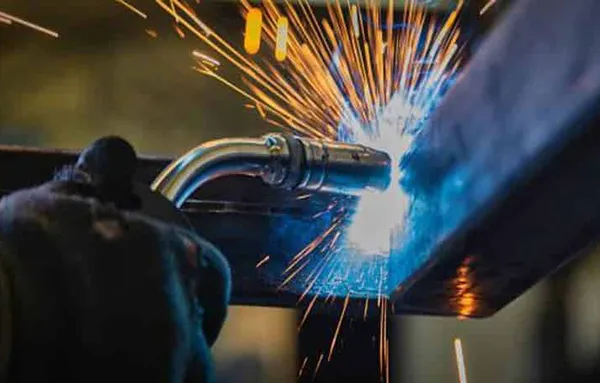

ERNiCrMo-13 is a nickel-chromium-molybdenum alloy welding wire known for its excellent resistance to a wide range of severe corrosive environments and high temperatures. This alloy is particularly effective for welding materials of similar composition and is widely used in industries where resistance to both oxidizing and reducing conditions is critical.
ERNiCrMo-13 is commonly used in chemical processing equipment, petrochemical facilities, marine and offshore engineering, pollution control systems, and power generation. The wire delivers smooth arc characteristics, low spatter, and stable metal transfer, enabling fabricators to achieve consistent weld quality on demanding projects.
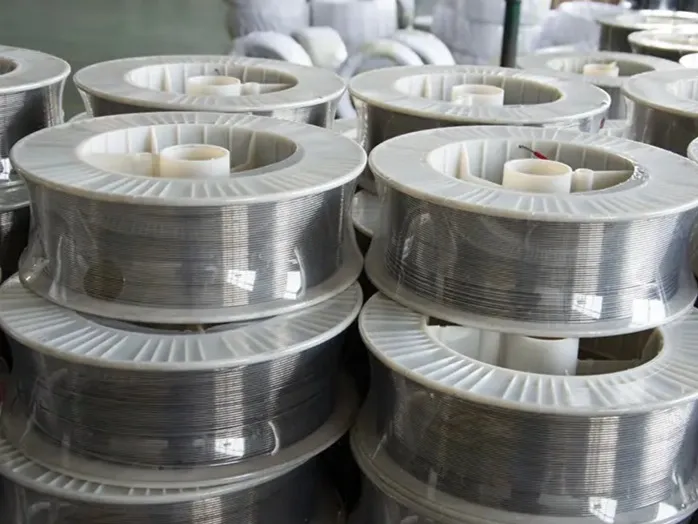
ERNiCrMo-13
| Standard | Classification |
| AWS A5.14 | ERNiCrMo-13 |
| EN ISO 18274 | S Ni 6059 (NiCr23Mo16) |
| ASME IX | F-No. 43 |
| DIN Mat.-No. | 2.4607 |
Note: ERNiCrMo-13 is suitable for TIG (GTAW) and MIG (GMAW) welding processes, especially for aggressive corrosive service environments and high-temperature applications.
| Element | Ni | Cr | Mo | Fe | Mn | Si | C | P | S | Co |
| Content (%) | 55.0–63.0 | 20.0–23.0 | 15.0–17.0 | 4.0–7.0 | ≤ 1.0 | ≤ 0.10 | ≤ 0.020 | ≤ 0.030 | ≤ 0.015 | ≤ 0.30 |
The balanced nickel-chromium-molybdenum composition provides outstanding resistance to pitting, crevice corrosion, and stress corrosion cracking in chloride-containing environments.
| Property | AWS Standard (min.) | Typical Value |
| Tensile Strength | ≥ 760 MPa (110 ksi) | ≥ 750–770 MPa |
| Yield Strength (0.2% offset) | Not specified | ≥ 320–450 MPa |
| Elongation (4d) | Not specified | ≥ 30–40% |
Note: Typical values are for reference only. Actual mechanical properties may vary depending on welding parameters, joint design, and base material condition.
Ø Excellent resistance to pitting, crevice corrosion, and chloride ion stress corrosion cracking
Ø Outstanding performance in both oxidizing and reducing acid media
Ø Good resistance to seawater and marine atmosphere corrosion
Ø Low carbon content prevents intergranular corrosion
Ø Excellent thermal stability for service up to approximately 1000°C (1800°F)
Ø Smooth arc characteristics for efficient TIG and MIG welding operations
| Category | Details |
| Base Materials | Alloy 59 (UNS N06059), Hastelloy® C-22® (UNS N06022), Hastelloy® C-276 (UNS N10276), Inconel® 625 (UNS N06625), Incoloy® 825 (UNS N08825), superaustenitic stainless steels (S31254, S32654), and dissimilar joints with stainless steels or carbon steels |
| Industrial Applications | Chemical processing reactors and heat exchangers, absorption towers, pharmaceutical equipment, marine and offshore engineering, pollution control systems, power generation boilers, industrial effluent treatment plants |
| Service Environment | Sulfuric acid, hydrochloric acid, phosphoric acid, chloride-bearing solutions, seawater, marine atmospheres, high-temperature oxidizing/reducing conditions |
| Welding Process | TIG (GTAW), MIG (GMAW) |
| Shielding Gas | Pure Argon (TIG); Ar/He mixtures (MIG) |
| Available Form | Bare wire, spool wire, TIG cut lengths |
Diameter options:
Packaging:
Custom packaging available upon request.
Ø Reliable production quality meeting AWS A5.14 requirements
Ø Strict quality control for corrosion-resistant alloy wires
Ø Clean wire surface for smooth feeding and stable arc
Ø Global export experience with on-time delivery
Ø Experts for pre-sale and after-sale assistance
1. What is ERNiCrMo-13 welding wire used for?
ERNiCrMo-13 is used for welding nickel-chromium-molybdenum alloys such as Alloy 59, Hastelloy C-22, Hastelloy C-276, Inconel 625, and Incoloy 825, as well as superaustenitic stainless steels and dissimilar joints.
2. Can ERNiCrMo-13 weld Hastelloy C-22?
Yes. ERNiCrMo-13 is suitable for welding C-22 alloy, as confirmed by multiple welding consumable manufacturers. For applications requiring a perfect composition match to C-22, ERNiCrMo-10 is recommended as the dedicated filler metal.
3. What are the key corrosion resistance properties?
It provides excellent resistance to pitting, crevice corrosion, and chloride ion stress corrosion cracking, and performs well in both oxidizing and reducing acid media, including sulfuric acid, hydrochloric acid, and phosphoric acid.
4. What is the maximum service temperature?
ERNiCrMo-13 can withstand temperatures up to approximately 1000°C (1800°F) without significant loss of mechanical properties or corrosion resistance.
5. Which welding processes are recommended?
Both TIG (GTAW) and MIG (GMAW) are suitable. Pure argon is recommended for TIG welding, while argon-helium mixtures are preferred for MIG applications.


 English
 Español
 русский язык
 اللغة العربية