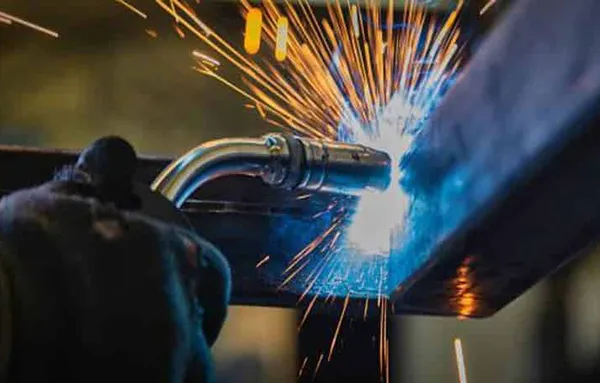

ERNiMo-7 is a nickel-molybdenum alloy welding wire designed for welding nickel-molybdenum alloys such as Hastelloy® B-2 (UNS N10665) and Hastelloy® B-3 (UNS N10675). This alloy features an exceptionally high molybdenum content, which provides outstanding resistance to severe reducing corrosive environments, particularly hydrochloric acid at all concentrations and temperatures.
ERNiMo-7 is commonly used in chemical processing equipment, petrochemical facilities, pharmaceutical manufacturing, pollution control systems, and acetic/phosphoric acid production plants. The wire delivers stable arc characteristics, low spatter, and smooth metal transfer, enabling fabricators to achieve consistent weld quality on demanding projects.
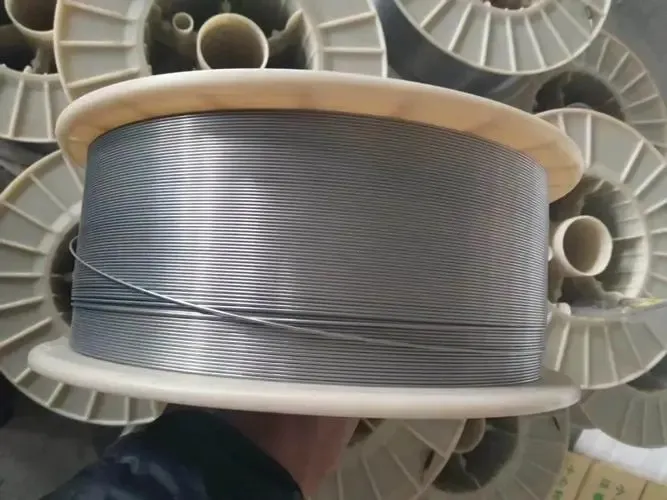
ERNiMo-7
| Standard | Classification |
| AWS A5.14 | ERNiMo-7 |
| ASME SFA-5.14 | ERNiMo-7 |
| Corresponding Base Alloy | Hastelloy B-2 (UNS N10665) |
| Corr. A5.11/A5.11M | ENiMo-7 |
Note: ERNiMo-7 is suitable for TIG (GTAW) and MIG (GMAW) welding processes, as well as plasma arc welding (PAW), especially for aggressive reducing corrosive service environments.
| Element | Ni | Mo | Fe | C | Mn | Si | Co | P | S |
| Content (%) | Balance (65% min.) | 26.0–30.0 | ≤ 2.0 | ≤ 0.02 | ≤ 1.0 | ≤ 0.10 | ≤ 1.0 | ≤ 0.030 | ≤ 0.015 |
The nickel-molybdenum composition with high molybdenum content provides exceptional resistance to uniform corrosion in reducing media and outstanding resistance to pitting and crevice corrosion.
| Property | Typical Value |
| Tensile Strength | ≥ 690–760 MPa |
| Yield Strength (0.2% offset) | ≥ 310 MPa |
| Elongation (4d) | ≥ 20–30% |
| Melting Range | 1330–1380°C |
| Density | ~9.2 g/cm³ |
Note: Typical values are for reference only. Actual mechanical properties may vary depending on welding parameters, joint design, and base material condition
Ø Exceptional resistance to uniform corrosion in reducing acid media (hydrochloric acid, sulfuric acid, phosphoric acid, acetic acid)
Ø Excellent resistance to pure hydrochloric acid across a wide range of concentrations and temperatures under reducing conditions
Ø Good resistance to pitting and crevice corrosion in chloride-containing environments
Ø Natural immunity to chloride stress corrosion cracking due to fully austenitic structure
Ø Very low carbon content prevents carbide precipitation and intergranular corrosion
Ø Low iron and silicon contents minimize formation of brittle intermetallic phases during thermal processing
Ø Excellent thermal stability for service in demanding reducing environments
Ø Smooth arc characteristics for efficient TIG and MIG welding operations
| Category | Details |
| Base Materials | Hastelloy® B-2 (UNS N10665), Hastelloy® B-3 (UNS N10675), and other nickel-molybdenum alloys; dissimilar joints with carbon steels or other nickel alloys |
| Industrial Applications | Hydrochloric acid reactors, heat exchangers, piping and storage tanks; sulfuric acid processing equipment; acetic and phosphoric acid production; pump and valve components; flue gas desulfurization systems; pharmaceutical and synthetic fiber equipment |
| Service Environment | Hydrochloric acid (all concentrations), sulfuric acid, phosphoric acid, acetic acid, reducing chemical media, chloride-containing solutions |
| Welding Process | TIG (GTAW), MIG (GMAW), PAW (Plasma Arc Welding) |
| Shielding Gas | Pure Argon (TIG); Ar/He mixtures (MIG) |
| Available Form | Bare wire, spool wire, TIG cut lengths |
Diameter options:
Packaging:
Ø Reliable production quality meeting AWS A5.14 requirements
Ø Strict quality control for nickel-molybdenum alloy wires
Ø Clean wire surface for smooth feeding and stable arc
Ø Global export experience with on-time delivery
Ø Technical support for welding procedure qualification
1. What is ERNiMo-7 welding wire used for?
ERNiMo-7 is primarily used for welding nickel-molybdenum alloys such as Hastelloy® B-2 (UNS N10665) and Hastelloy® B-3 (UNS N10675), as well as for cladding steel with nickel-molybdenum weld metal and dissimilar joints.
2. What are the key corrosion resistance properties of ERNiMo-7?
It provides exceptional resistance to uniform corrosion in reducing acid media, particularly hydrochloric acid at all concentrations and temperatures. It also offers excellent resistance to pitting, crevice corrosion, and natural immunity to chloride stress corrosion cracking.
3. In what environments should ERNiMo-7 NOT be used?
ERNiMo-7 should NOT be used in strong oxidizing environments (such as concentrated nitric acid, or hydrochloric acid containing high-valent iron/copper ions or free chlorine), as oxidizing conditions rapidly disrupt its passive film.
4. Which welding processes are recommended?
TIG (GTAW), MIG (GMAW), and plasma arc welding (PAW) are all suitable. Pure argon is recommended for TIG welding, while argon-helium mixtures are preferred for MIG applications.
5. What is the interpass temperature control requirement?
Interpass temperature should be strictly controlled to below 120°C to prevent weld metal overheating and grain growth


 English
 Español
 русский язык
 اللغة العربية