
 PDF Download
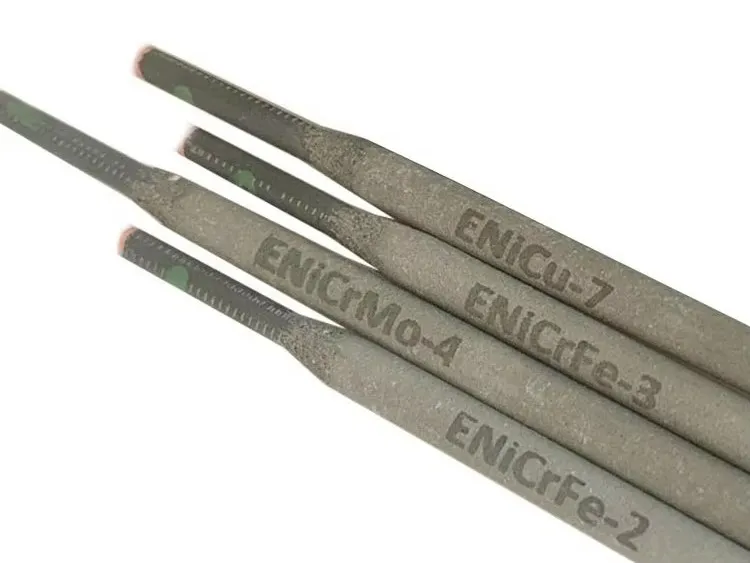
ENiCu-7 is a low‑hydrogen coated nickel‑copper alloy electrode designed for welding Monel alloys 400, R‑405, K‑500 and for dissimilar joints between nickel‑copper alloys and carbon steel, low alloy steel, copper, and copper‑nickel alloys.
The weld metal offers excellent corrosion resistance in seawater, salt solutions, reducing acids, and alkaline media. With a stable arc, low spatter, and easy slag removal, ENiCu‑7 operates on DC+ (reverse polarity) and is suitable for flat, fillet, vertical, and overhead welding.
ENiCu-7
| Standard | Designation |
| AWS A5.11 | ENiCu-7 |
| GB/T 13814 | ENi4060 |
| EN ISO 14172 | E Ni 4060 (NiCu30Mn3Ti) |
| JIS Z3224 | DNiCu-7 |
| UNS | W82140 |
| Element | Ni+Co | C | Mn | Fe | S | Si | Cu | Al | Ti | P | Others |
| Content(%) | 62.0-68.0 | ≤ 0.15 | ≤ 4.0 | ≤ 2.5 | ≤ 0.015 | ≤ 1.0 | Remainder | ≤ 0.75 | ≤ 1.0 | ≤ 0.02 | ≤ 0.50 |
| Property | AWS Requirement | Typical Value |
| Tensile Strength | ≥ 480 MPa (70 ksi) | 480 – 550 MPa |
| Yield Strength | — | 310 – 380 MPa |
| Elongation | ≥ 30% | 30 – 45% |
| Hardness | — | 120 – 150 HB |
| Diameter (mm) | Length (mm) | Flat Position Current (A) | Vertical / Overhead (A) |
| 2.4 – 2.6 | 300 | 50 – 85 | 50 – 75 |
| 3.2 | 350 | 70 – 120 | 65 – 110 |
| 4.0 | 350 | 90 - 170 | 85 – 140 |
| 4.8 – 5.0 | 350 | 110 – 180 | — |
| Category | Typical Uses |
| Monel alloy welding | Monel 400, R‑405, K‑500 – valves, pumps, propellers, shafts, heat exchangers |
| Dissimilar metal joints | Monel to carbon/low‑alloy steel, Monel to stainless steel, Monel to copper/copper‑nickel |
| Surfacing & clad welding | Nickel‑copper overlay on carbon steel, repair of Monel‑clad plates |
| Marine engineering | Seawater piping systems, pumps, valves, propeller shafts, desalination plants, offshore structures |
| Chemical & petrochemical | Reactors, vessels, piping, electroplating equipment, PVC production, acid handling |
| Power generation | Flue gas desulfurization (FGD) systems, seawater cooling systems, heat exchangers |
| Parameter | Requirement |
| Cleaning | Remove oil, rust, moisture |
| Preheat | 100–150°C (thick or restrained joints only) |
| Interpass Temp | ≤100°C |
| Polarity | DC+ (reverse polarity) |
| Technique | Short arc, low current, narrow beads, fast speed |
| Drying | 250–350°C × 30–60 min |
Store electrodes in a dry, well‑ventilated warehouse. Keep in original packaging until use.
Redry as specified above if moisture absorption occurs.
Standard packaging:
1. What is ENiCu-7 welding electrode used for?
ENiCu-7 is used for welding nickel-copper alloys, dissimilar metals, and applications requiring strong corrosion resistance in marine and chemical environments.
2. Can ENiCu-7 be used for repair welding?
Yes. It is widely used for repair and maintenance welding due to its good crack resistance and adaptability.
3. What polarity should be used?
DC positive is recommended for stable arc and optimal weld quality.
4. What is the difference between ENiCu-7 and ERNiCu-7?
ENiCu-7 is a covered electrode, while ERNiCu-7 is a solid wire used for MIG/TIG welding. Both have similar chemical composition but are used in different welding processes.


 English
 Español
 русский язык
 اللغة العربية