

 PDF Download
ENiCrFeNb-7 is a nickel-chromium-iron alloy covered electrode (low-hydrogen type) designed for welding high-chromium nickel-based alloys such as Inconel® 690 (UNS N06690). The nominal composition of the weld deposit is approximately 55Ni-29Cr-9.5Fe-3Mn-1.5Nb+Ta, providing outstanding resistance to stress corrosion cracking (SCC) and intergranular corrosion (IGC), particularly in nuclear radiation and pure water environments. The low-hydrogen sodium coating ensures smooth arc characteristics, low spatter, easy slag removal, and stable metal transfer, enabling fabricators to achieve consistent weld quality on demanding projects.
ENiCrFeNb-7 is widely used in nuclear power plant construction (reactor pressure vessels, steam generators, pressurizers), chemical processing equipment (sulfuric acid, nitric acid, hydrofluoric acid manufacturing), and dissimilar metal joints between nickel alloys and stainless or low-alloy steels. The electrode delivers excellent operability in all positions, high resistance to hot cracking, and superior corrosion resistance for severe service environments, particularly in the nuclear industry.
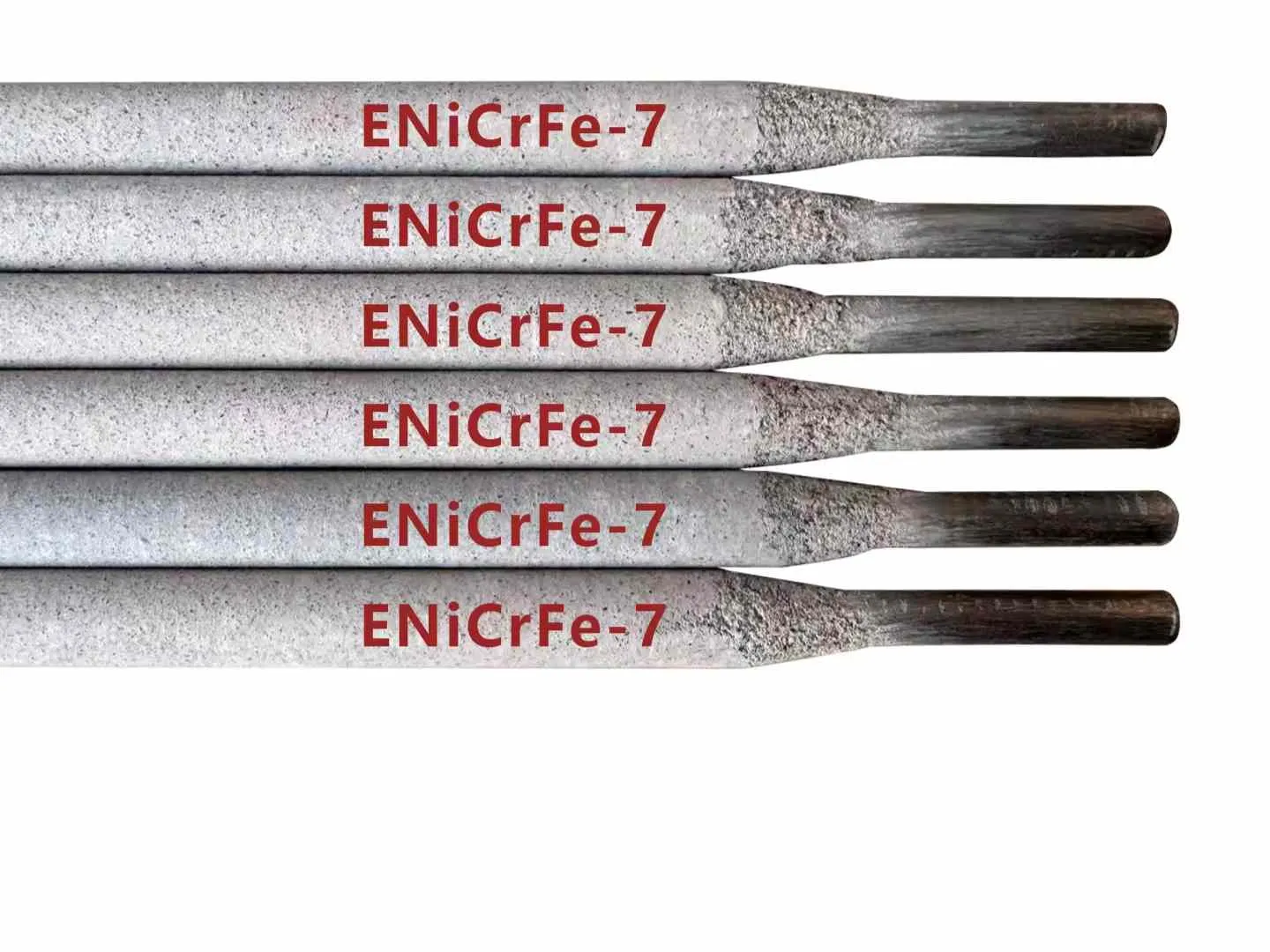
ENiCrFe-7
| Standard | Classification |
|---|---|
| AWS A5.11 | ENiCrFe‑7 (ENiCrFeNb‑7) |
| ASME II, Part C, SFA‑5.11 | ENiCrFe‑7 |
| UNS | W86152 |
| EN ISO 14172 | E Ni 6152 (NiCr30Fe9Nb) |
| GB/T 13814 | ENiCrFe‑7 |
Custom specifications available upon request.
For information regarding certifications and industry approvals, please contact our Technical Department.
| Element | C | Mn | Si | S | P | Ni | Cr | Fe | Nb+Ta | Cu | Mo |
| Content (%) | 0.05 max | 5.0 max | 0.75 max | 0.015 max | 0.020 max | Balance | 28.0–31.5 | 7.0–12.0 | 1.0–2.5 | 0.50 max | 0.50 max |
| Property | AWS Standard (min.) | Typical Value |
|---|---|---|
| Tensile Strength, MPa (ksi) | ≥ 550 (80) | ≥ 590–670 (85–95) |
| Yield Strength (0.2% offset), MPa | ≥ 360 | ≥ 370–430 |
| Elongation (4d), % | ≥ 27 | ≥ 35–44 |
Note: The above values are minimum requirements per AWS A5.11. Typical values are for reference only and may vary depending on welding parameters, joint design, and base material condition
Ø Outstanding stress corrosion cracking (SCC) resistance: High chromium content (28.0–31.5%) provides superior resistance to SCC in nuclear radiation, pure water, and aggressive corrosive environments
Ø Excellent intergranular corrosion (IGC) resistance: Low carbon content and niobium/tantalum additions prevent carbide precipitation at grain boundaries, eliminating susceptibility to intergranular attack
Ø Low‑hydrogen coating: Minimizes hydrogen‑induced cracking, particularly critical for high-strength steels and thick sections in nuclear applications
Ø Excellent high-temperature oxidation resistance: Scaling resistance up to approximately 1100°C (2010°F) in air
Ø Good resistance to hot cracking: Niobium addition refines the weld microstructure and reduces solidification cracking tendency
Ø Smooth arc characteristics: Low spatter, easy slag removal, stable metal transfer, and good porosity resistance
Ø All-position weldability: Excellent operability in flat, horizontal, vertical up, and overhead positions
Ø 100% joint efficiency: Weld metal exhibits mechanical properties equivalent to the base material
| Category | Details |
|---|---|
| Nickel Alloys | Inconel® 690 (UNS N06690), Inconel® 600 (UNS N06600), and other nickel‑chromium‑iron alloys; ASTM B166, B167, B168 specifications |
| Dissimilar Metal Joints | Nickel alloys to stainless steels, nickel alloys to low‑alloy steels, nickel alloys to carbon steels, and Inconel to Incoloy alloys |
| Corrosion Resistant Overlays | Surfacing corrosion resistant layers on low‑alloy steel and stainless steel substrates |
| Industrial Applications | Nuclear island main equipment: reactor pressure vessels, steam generators, pressurizers, and core internals; chemical processing: sulfuric acid, nitric acid, and hydrofluoric acid manufacturing equipment; power generation components; pulp and paper processing; pollution control systems; pharmaceutical equipment |
Polarity: Direct Current, Electrode Positive (DCEP / DC reverse polarity)
Pre‑weld Preparation:
Electrode Conditioning:
Recommended Current Range:
| Electrode Diameter (mm) | Current Range (Amperes) |
|---|---|
| φ2.5 | 50–70 |
| φ3.2 | 70–110 |
| φ4.0 | 110–170 |
For vertical and overhead welding, reduce current by approximately 10–15%.
Welding Techniques:
Ø Use a short arc length to minimize atmospheric contamination and prevent porosity
Ø Control interpass temperature below 150°C (300°F) to reduce cracking tendency
Ø Minimize heat input; if weaving, do not exceed twice the electrode diameter in width
Ø Remove slag thoroughly between passes
Ø Preheating is generally not required for most applications
Ø For thick sections or high-constraint structures, consider preheating of 80–150°C (175–300°F)
Diameter options:
Packaging:
Ø Reliable production quality meeting AWS A5.11 and ASME SFA‑5.11 requirements
Ø Strict quality control for nickel‑based alloy electrodes
Ø Low‑hydrogen coating ensures smooth arc, low spatter, and easy slag removal
Ø Global export experience with on‑time delivery
Ø Technical support for welding procedure qualification
1. What is ENiCrFeNb-7 (ENiCrFe-7) welding electrode used for?
ENiCrFeNb-7 is primarily used for welding Inconel® 690 (UNS N06690) and other nickel‑chromium‑iron alloys, particularly in nuclear power plant construction (reactor pressure vessels, steam generators, pressurizers). It is also used for dissimilar metal joints between nickel alloys and stainless or low‑alloy steels, and for surfacing corrosion resistant layers on steel substrates.
2. What are the key corrosion resistance properties of ENiCrFeNb-7?
It provides outstanding resistance to stress corrosion cracking (SCC) in nuclear radiation and pure water environments, as well as excellent intergranular corrosion (IGC) resistance. The high chromium content (28.0–31.5%) is key to its superior SCC performance.
3. Is ENiCrFeNb-7 the same as ENiCrFe-7?
Yes, ENiCrFeNb-7 and ENiCrFe-7 refer to the same AWS A5.11 classification. The "Nb" designation in the name explicitly indicates the presence of niobium (columbium) in the alloy composition, which is an essential element for the specification.
4. What polarity and current are required?
ENiCrFeNb-7 operates with Direct Current, Electrode Positive (DCEP / DC reverse polarity). Refer to the recommended current range based on electrode diameter.
5. What is the recommended interpass temperature?
Interpass temperature should be controlled below 150°C (300°F) to prevent weld metal overheating and reduce cracking tendency. Effective welding below 150°C is recommended for reduced cracking tendency.
6. How should ENiCrFeNb-7 electrodes be stored and conditioned?
ENiCrFeNb-7 electrodes have a low‑hydrogen coating and must be stored in a dry environment. Before use, electrodes should be baked at 300–350°C (570–660°F) for 1 hour to remove moisture and prevent hydrogen‑induced cracking. Do not rebake more than twice.
7. Is preheating required for ENiCrFeNb-7 welding?
Preheating is generally not necessary for most applications. However, for thick sections or high-constraint structures, preheating of 80–150°C (175–300°F) may be beneficial.
8. What is the maximum service temperature for ENiCrFeNb-7?
ENiCrFeNb-7 weld metal exhibits scaling resistance up to approximately 1100°C (2010°F) in air. For long-term service in aggressive environments, consult the applicable design codes and base material specifications.


 English
 Español
 русский язык
 اللغة العربية