Stainless steel is widely known for its excellent corrosion resistance and strength, making it a popular choice in everything from kitchen equipment to chemical plants. However, its unique metallurgical properties make welding stainless steel more challenging compared to ordinary carbon steel. Using the wrong electrode or filler wire can not only compromise weld strength but also destroy the material's inherent corrosion resistance, potentially leading to weld rust or even cracking. Therefore, understanding what electrode is used to weld stainless steel is a vital skill for any welder or fabricator.
In this guide, we'll walk you through the key factors to consider, the most common types of stainless steel electrodes, and practical tips to help you make the best choice for every welding task.
Why Does Stainless Steel Need Special Electrodes for Welding?
Stainless steel earns its "stainless" label thanks to its chromium content at least 10.5%, which forms a passive layer of chromium oxide on the surface. This layer protects the material from oxidation and corrosion. However, during welding, if an incorrect filler metal is used, the chemical composition of the weld area changes, which can lead to several serious problems:
-
Weld Cracking: Mismatched electrodes can result in hot or cold cracking during the cooling and contraction phases.
-
Loss of Corrosion Resistance: Using the wrong electrode can cause "intergranular corrosion," which occurs along grain boundaries. This can lead to weld failure even when it appears intact.
-
Weld Contamination: Harmful elements from an incompatible electrode can contaminate the weld, weakening its mechanical properties.
This is why selecting the right stainless steel welding electrode is critical for achieving strong, durable, and corrosion-resistant welds.
Understanding the AWS Naming System for Stainless Steel Electrodes
Stainless steel stick electrodes for SMAW generally follow the American Welding Society A5.4 standard. Understanding the meaning behind the numbers and letters in the electrode's name is key to making the right choice. For example, take the common electrode “E308L-16”:
-
"E" stands for "Electrode".
-
"308" represents the core number, which indicates the chemical composition of the deposited weld metal, mainly aligned with the alloy content of AISI 300 series stainless steels.
-
"L" stands for "Low Carbon", typically ≤ 0.03% or 0.04% carbon, which helps prevent intergranular corrosion during welding. It’s the go-to choice for most stainless steel applications.
-
The "16" two-digit suffix indicates the electrode's usability characteristics, including the flux type and suitable current/position:
-
-15– Suitable for DCEN or DCEP only, with a "basic" or "lime" flux. The slag solidifies quickly and is best for all-position welding (vertical, overhead). It’s commonly used for critical applications that require high mechanical properties.
-
-16– Suitable for both AC/DC with a "titania" or "rutile" flux. This type provides a stable arc, low spatter, and easy slag removal, making it highly versatile and suitable for all-position welding.
-
-17– Similar to -16 but with a higher rutile content, giving a softer arc and a finer ripple pattern.
How to Choose the Right Stainless Steel Electrode
The right electrode depends on the base metal type and the environment in which the weld will be used. Here are the most commonly used stainless steel electrodes, along with some tips for selecting the best one for your needs.
1. E308 / E308L: The All-Purpose "Go-To" Electrode
-
Base metals: Primarily used for welding 304 and 304L stainless steel, but also suitable for 301, 302, and other 18-8 type (18% Cr, 8% Ni) austenitic stainless steels.
-
Typical applications: Food processing equipment, dairy tanks, chemical containers, general piping, and kitchen equipment.
-
Selection tip: For welding 304 stainless steel, E308L is the standard and reliable choice. The “L” grade minimizes the risk of intergranular corrosion.
2. E309 / E309L: The "Bridge" for Dissimilar Metals
-
Base metals: Ideal for welding stainless steel to carbon steel or low-alloy steel. It's also commonly used for welding 309 stainless steel or applying stainless steel overlays (e.g., corrosion-resistant layers on carbon steel).
-
Typical applications: Petrochemical plant piping, refinery equipment, high-temperature components, and transition joints.
-
Selection tip: E309L has high chromium and nickel content, providing a buffer layer that prevents the formation of brittle phases and ensures the strength and toughness of dissimilar metal joints.
3. E316 / E316L: The "Guardian" of Corrosion Resistance
-
Base metals: Designed specifically for welding 316 and 316L stainless steel.
-
Typical applications: Marine engineering equipment, seawater piping, chemical and pharmaceutical industry equipment, and environments exposed to chlorides (e.g., salt), which cause pitting corrosion.
-
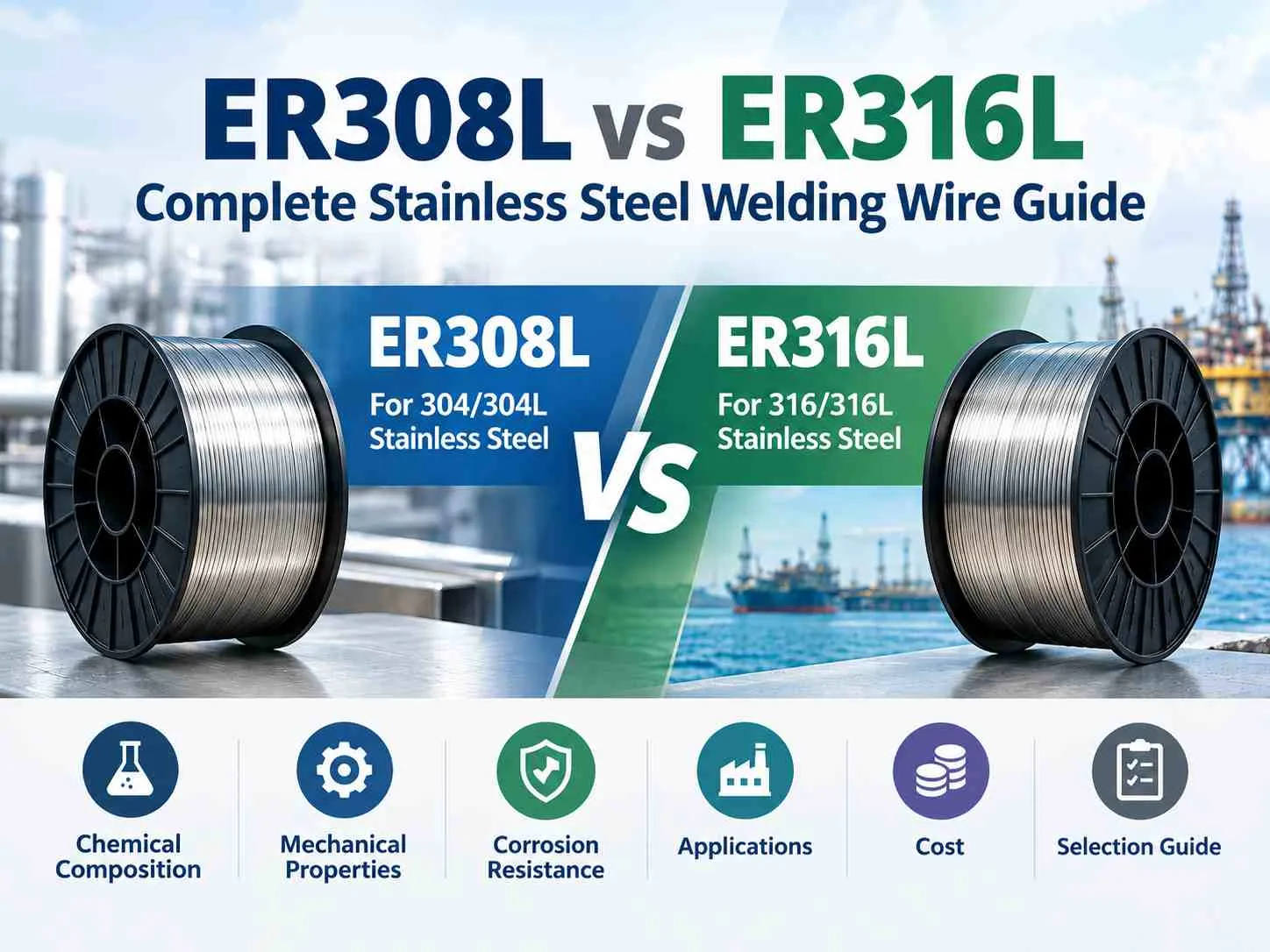
Selection tip: Due to the addition of molybdenum (Mo), E316L offers far superior resistance to pitting and crevice corrosion compared to E308L. It’s the best choice for applications in saltwater or highly corrosive chemicals.
4. E310 / E310H: The High-Temperature "Resistant" Electrode
-
Base metals: Used for welding 310 stainless steel or similar heat-resistant steels.
-
Typical applications: Furnace components, heat treatment equipment, heat exchangers, high-temperature exhaust pipes, and more.
-
Selection tip: E310 electrodes have exceptionally high chromium and nickel content, enabling them to maintain strength and oxidation resistance at temperatures up to 1150°C.
5. E347: The "Specialist" for Stabilized Grades
-
Base metals: For welding stabilized stainless steels containing titanium (e.g., Type 321) or niobium (e.g., Type 347).
-
Typical applications: Piping that operates at high temperatures for extended periods (e.g., boilers, superheaters) or equipment used in the nuclear industry.
-
Selection tip: The addition of niobium (Nb) prevents intergranular corrosion, making it ideal for situations where post-weld solution heat treatment is not feasible.
Quick Selection Guide for Stainless Steel Electrodes
|
Base Metal Type
|
Recommended Electrode (AWS)
|
Key Advantage
|
|
304 / 304L
|
E308L-16
|
Excellent corrosion resistance, cost-effective, highly versatile
|
|
316 / 316L
|
E316L-16
|
Superior resistance to chloride pitting and crevice corrosion; ideal for marine/chemical
|
|
Stainless steel to carbon steel
|
E309L-16
|
Great for dissimilar metals; prevents cracking and provides a buffer layer
|
|
321 / 347
|
E347-16
|
Prevents intergranular corrosion; suitable for high-temperature service
|
|
High-temperature environment
|
E310-16
|
Outstanding high-temperature oxidation and creep resistance
|
Practical Tips for Welding Stainless Steel
Choosing the right electrode is just half the job. Proper technique is equally important.
-
Control Heat Input: Stainless steel has relatively low thermal conductivity, which means heat builds up easily. Excessive heat input can cause grain coarsening in the heat-affected zone, reducing corrosion resistance. A general rule is to use about 2/3 of the amperage you would use for the same thickness of carbon steel. Additionally, use a faster travel speed to avoid overheating the base metal.
-
Drying and Storing Electrodes: Stainless steel electrodes are hygroscopic. They absorb moisture easily. Moisture in the weld can lead to hydrogen-induced cracking and porosity. Before use, electrodes should be baked at 200–250°C (400–480°F) for about 60 minutes and stored in a heated electrode holder at 100–150°C (210–300°F).
-
Clean the Workpiece Thoroughly: Stainless steel is extremely sensitive to contamination. Before welding, use adedicated stainless steel wire brushor abrasive disc to remove any oil, grease, dirt, and even fingerprints. Never use tools that have been used on carbon steel, as this can leave iron particles on the surface, leading to rust later.
-
Choose the Right Welding Process:
-
SMAW (Stick Welding): Ideal for field work and thicker plates, offering flexibility. Use EXXX-16 or EXXX-17 electrodes for good performance.
-
GTAW (TIG Welding): Suitable for thin sheets, tubing, and high-precision requirements. Common AWS filler wires include ER308L, ER316L, etc., and TIG welding typically uses 100% argon shielding gas.
-
GMAW (MIG Welding): Great for automated production and thick plates. Usually requires a mixed gas (e.g., 98% Ar + 2% CO₂) for shielding.
Common Mistakes to Avoid in Stainless Steel Welding
-
Mistake 1: Using E308L to weld 316 stainless steel. In chloride-rich environments, E308L will have much lower corrosion resistance than E316L, leading to premature weld failure.
-
Mistake 2: Using carbon steel tools on stainless steel. Carbon steel wire brushes can embed carbon particles in the stainless steel, causing "iron contamination" and eventual rust.
-
Mistake 3: Skipping the "L" grade. In applications that demand high corrosion resistance, using a non-L grade (e.g., E308 instead of E308L) can cause intergranular corrosion due to carbide precipitation.
What Electrode Should You Use for Welding Stainless Steel?
To answer the original question:"What electrode is used to weld stainless steel?" The answer depends on the specific job.
E308L is the go-to electrode for welding 304 stainless steel, while E316L offers extra protection in highly corrosive environments like marine or chemical applications. E309L is ideal for joining stainless steel to carbon steel.
By understanding these key electrodes and applying proper welding techniques, you'll ensure top-quality welds every time.
About Ronsco
Ronsco is a trusted global supplier of nickel alloy and stainless steel welding wires, including Inconel, Hastelloy, and Monel series. Our products are manufactured to meet industry standards and are widely used in demanding applications such as aerospace, oil & gas, chemical processing, and power generation. Explore our resource center for the latest industry insights, product knowledge, and technical references.
Contact us for a quote or technical assistance.