

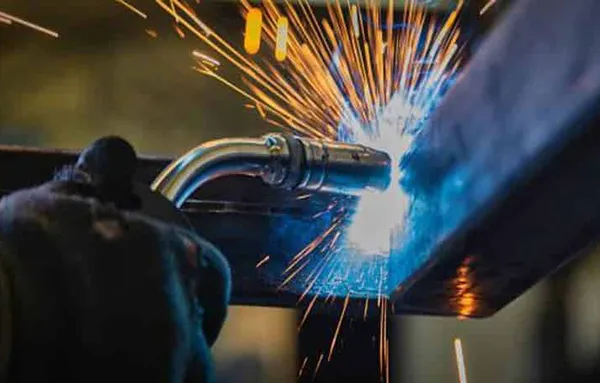
When MIG welding mild steel, few decisions affect weld quality as much as your filler wire choice. ER70S-3 and ER70S-6 look nearly identical. But their subtle chemical differences can mean the difference between a clean, strong weld and a porous failure.
This guide covers everything you need to know about ER70S-6 and ER70S-3: chemical makeup, performance, ideal applications, and a simple framework for choosing the right wire.
Both wires fall under the AWS A5.18 specification for carbon steel filler metals:
Both are designed for MIG welding of mild and carbon steels. The number indicates alloy content differences and that’s where the real distinction lies.
The primary difference is deoxidizer levels specifically silicon and manganese. These elements bind with oxygen in the weld pool, preventing porosity. ER70S-6 contains significantly higher silicon and manganese than ER70S-3.
|
Element |
Typical Range |
|
Manganese (Mn) |
1.40–1.85% |
|
Silicon (Si) |
0.80–1.15% |
|
Carbon (C) |
0.06–0.15% |
|
Element |
Typical Range |
|
Manganese (Mn) |
0.90–1.40% |
|
Silicon (Si) |
0.45–0.70% |
|
Carbon (C) |
0.06–0.15% |
The extra deoxidizers in ER70S-6 act like a cleaning agent. They “boil out” impurities before the weld solidifies.
|
Feature |
ER70S-6 |
ER70S-3 |
|
Tensile Strength |
70,000 PSI |
70,000 PSI |
|
Deoxidizer Level |
High |
Moderate |
|
Best For |
Dirty/rusty steel, mill scale, single-pass welds |
Clean steel, multi-pass welds, automotive sheet |
| Surface Condition | Handles light rust, mill scale, oils | Requires clean, oil-free metal |
| Puddle Fluidity | Very fluid, excellent wetting | Less fluid, narrower bead |
| Spatter Level | Moderate | Low |
| Shielding Gas | C25 or 100% CO₂ | C25 only (100% CO₂ not recommended) |
| Silicon Islands | May form deposits | Minimal |
| Cost | Slightly higher | Lower |
| Typical Apps | Structural, shipbuilding, repair | Sheet metal, automotive, painted finishes |
ER70S-6 is the most widely used MIG wire for mild steel. Its popularity comes from one key advantage: tolerance to surface contamination.
The base metal has mill scale, light rust, or surface oils.
You want a universal wire for varying material conditions.
Fit-up is imperfect (the fluid puddle bridges gaps well).
Working outdoors or in less controlled environments.
Performing single-pass welding.
Forgiving on contamination – Higher Mn/Si neutralizes light rust and oil, reducing porosity.
Excellent wetting action – Produces smooth, flat beads with good fusion.
Versatile shielding gas – Works with both C25 and 100% CO₂.
All-position capability – Suitable for flat, horizontal, vertical, and overhead.
Good mechanical properties – High tensile strength (≥480 MPa) and elongation (22–30%).
Structural steel - Beams, columns, trusses for building and bridge construction
Shipbuilding – Hull sections, decks, bulkheads where mill scale is common
Automotive manufacturing – Body panels, chassis components, repair work
General manufacturing – Frames, enclosures, machinery across various material thicknesses
Maintenance and repair (MRO) – Field repairs where surface conditions vary
Pipe and tube welding – Root runs and joint completion
Silicon islands – The higher silicon can leave glass-like deposits. If paint is applied, these may cause flaking. In multi-pass welding, they can appear as slag inclusions on X-ray.
Moderate spatter – Slightly more than ER70S-3, especially with 100% CO₂.
Slightly higher cost – Due to additional alloying elements.
ER70S-3 is designed for general fabrication of mild steels. Its lower silicon and manganese make it better for applications where reduced silicon content is preferred.
The base metal is clean, oil-free, and rust-free.
Multi-pass welding is required – Lower silicon content reduces the risk of silicon island accumulation between passes.
Paint adhesion is critical – Minimal silicon islands mean better paint bonding.
You want lower spatter – Produces a cleaner arc with less spatter than ER70S-6.
Cost is a primary consideration – Generally more affordable than ER70S-6.
Welding thin materials - Narrower bead profile offers better control.
Low silicon island formation – Best for painted finishes or X-ray quality multi-pass welds.
Low spatter – Cleaner welds with less post-weld cleanup.
Excellent for thin materials – Narrower bead profile and good penetration control.
Lower cost – More economical for high-volume production on clean material.
Automotive Sheet Metal – Body panels, thin-gauge fabrication
Metal Furniture – Clean welds with minimal post-weld finishing
General Fabrication on Clean Steel – Where surface preparation is consistent
Pressure Vessel Fabrication – For high-integrity root runs and joint completion
Applications with Paint Requirements – Where silicon islands could cause coating adhesion problems
No tolerance for contamination – Mill scale, light rust, or oils will likely cause porosity.
Not recommended with 100% CO₂ – Best with C25; pure CO₂ causes arc instability and increased spatter.
Narrower bead profile – Less “wash-in” at the weld toes, which may matter for fatigue-critical parts.
Poorer performance on rusty materials – Lower deoxidizers can’t neutralize contamination effectively.
C25 (75% Ar / 25% CO₂) – Smooth, stable arc, minimal spatter, clean bead appearance.
100% CO₂ – Deeper penetration, harsher arc with more spatter, lower cost. Suitable for thick plates and outdoor welding.
ER70S-6 performs well with both. For best appearance and minimal cleanup, use C25.
C25 – Recommended. Low spatter, smooth arc, good bead appearance.
100% CO₂ – Not recommended. Higher spatter, rougher arc, may cause weld defects.
Stick with C25 for ER70S-3.
| Diameter | Amperage Range | Material Thickness | Typical Use |
| 0.023″ (0.6mm) | 30–130A | 24–18 gauge | Automotive sheet, thin tubing |
| 0.030″ (0.8mm) | 40–145A | 18–14 gauge | General fabrication |
| 0.035″ (0.9mm) | 50–180A | 14 gauge–1/4″ | Most common all-purpose |
| 0.045″ (1.2mm) | 75–250A | 1/4″–1/2″ | Heavy structural |
| 0.052″ (1.6mm) | 100–300A | 1/2″+ | Industrial fabrication |
| Wire Type | Mill Scale | Light Rust | Clean Steel |
| ER70S-6 | Good | Good | Excellent |
| ER70S-3 | Not recommended | Not recommended | Excellent |
Both wires meet AWS A5.18 requirements with similar strength and elongation:
| Property | Typical Value | AWS Requirement |
| Tensile Strength | ≥480 MPa | 70,000 PSI min |
| Yield Strength | ≥400 MPa | — |
| Elongation | 22–30% | ≥22% |
ER70S-6 offers superior low-temperature impact strength (-29°C vs. -18°C for ER70S-3), making it better for cold-weather applications.
1. Can I use ER70S-6 and ER70S-3 interchangeably?
Not without understanding the consequences. While both will produce a weld, ER70S-3 on dirty steel will likely cause porosity. ER70S-6 on clean steel will work fine but may leave silicon islands that affect paint adhesion or X-ray quality.
2. Which wire is stronger?
Both wires meet the same minimum tensile strength requirement of 70,000 psi. The difference is not in strength but in contamination tolerance and weld puddle behavior.
3. Is ER70S-6 always better?
No. ER70S-6 is more versatile, but ER70S-3 has specific advantages: lower spatter, fewer silicon islands, and lower cost. For clean material with painting requirements or multi-pass X-ray work, ER70S-3 is often the better choice.
4. What about ER70S-2?
ER70S-2 contains even higher deoxidizer levels (including zirconium, aluminum, and titanium) and is designed for the most demanding applications, including welding over rusty surfaces. However, it can produce more slag formation. For most general fabrication, ER70S-6 strikes the best balance.
5. Can I use either wire for TIG welding?
Yes, both classifications can be used as filler rods for GTAW (TIG) welding, though ER70S-2 is often preferred for TIG applications due to its superior deoxidation
Selecting between ER70S-6 and ER70S-3 comes down to surface condition and finish requirements.
For most shops with varying material quality, ER70S-6 is the safe, versatile choice. Its higher deoxidizers handle real-world contamination. That’s why it’s the most widely used MIG wire for mild steel.
But for pristine paint adhesion, X-ray quality multi-pass welds, or minimal spatter on clean material, ER70S-3 remains excellent and is often more economical.
Know your material. Know your application. When in doubt about surface condition, choose ER70S-6.
Ronsco is a trusted global supplier of nickel alloy and stainless steel welding wires, including Inconel, Hastelloy, and Monel series. Our products are manufactured to meet industry standards and are widely used in demanding applications such as aerospace, oil & gas, chemical processing, and power generation. Explore our resource center for the latest industry insights, product knowledge, and technical references.
Contact us for a quote or technical assistance.


 English
 Español
 русский язык
 اللغة العربية