

In nickel-alloy welding, ERNiCrMo-4 and ERNiCrMo-10 are two widely used high-performance Ni-Cr-Mo filler wires. Both comply with AWS A5.14 and are commonly applied in chemical processing, marine engineering, pollution control, nuclear power, and other demanding service environments.
Although they share a similar alloy family, their differences in chromium, molybdenum, and tungsten content lead to distinct corrosion resistance characteristics. Understanding these differences is essential for selecting the correct filler metal and ensuring long-term weld performance.
This article provides a detailed comparison of ERNiCrMo-4 vs ERNiCrMo-10, including chemistry, corrosion behavior, applications, equivalent grades, and selection considerations.
ERNiCrMo-4 is the matching filler metal for Hastelloy C-276 (UNS N10276). With high molybdenum and tungsten content, it is specifically designed for excellent resistance to strongly reducing corrosive environments.
ERNiCrMo-10 corresponds to Hastelloy C-22 (UNS N06022) and is also known as Alloy 22 welding wire or C-22 filler wire. Developed with a higher chromium content and optimized Ni-Cr-Mo balance, it provides excellent resistance in both oxidizing and reducing environments.
The key difference between the two alloys is their corrosion resistance focus:
For engineers and purchasing teams, ERNiCrMo-4 and ERNiCrMo-10 may appear under different commercial or alloy designations.
| AWS Classification | Common Name | Base Alloy | UNS |
|---|---|---|---|
| ERNiCrMo-4 | C-276 welding wire / Hastelloy C-276 filler wire | Hastelloy C-276 | UNS N10276 |
| ERNiCrMo-10 | C-22 welding wire / Alloy 22 filler wire / Hastelloy C-22 welding wire | Hastelloy C-22 | UNS N06022 |
Although these filler metals are sometimes considered alternatives, the correct choice should always be based on the base material, corrosion environment, and project requirements.
Although both wires belong to the Ni-Cr-Mo family, differences in key alloying elements significantly influence their corrosion performance.
| Element (wt%) | ERNiCrMo-4 (C-276) | ERNiCrMo-10 (C-22) |
|---|---|---|
| Nickel (Ni) | ≥50 | ≥58 |
| Chromium (Cr) | 14.5–16.5 | 20.0–22.5 |
| Molybdenum (Mo) | 15.0–17.0 | 12.5–14.5 |
| Tungsten (W) | 3.0–4.5 | 2.5–3.5 |
| Iron (Fe) | 4.0–7.0 | 2.0–6.0 |
| Carbon (C) | ≤0.020 | ≤0.015 |
| Cobalt (Co) | ≤2.5 | ≤2.5 |
The main compositional difference lies in the balance between chromium and molybdenum:
Rather than one alloy being universally superior, the difference in chemistry gives each filler metal its own application advantage.
From a mechanical standpoint, ERNiCrMo-4 and ERNiCrMo-10 provide comparable weld performance.
| Property | ERNiCrMo-4 | ERNiCrMo-10 |
|---|---|---|
| Tensile Strength (MPa) | ~690–790 | ~690–790 |
| Elongation (%) | ≥30 | ~38–40 |
| Elastic Modulus (GPa) | 220 | 220 |
| Poisson’s Ratio | 0.29 | 0.29 |
Both filler metals offer high tensile strength and good ductility. Therefore, mechanical properties are usually not the primary factor when selecting between ERNiCrMo-4 and ERNiCrMo-10. The final decision is mainly determined by corrosion requirements and base metal compatibility.
The primary difference between ERNiCrMo-4 and ERNiCrMo-10 lies in their corrosion resistance characteristics.
The choice between ERNiCrMo-4 and ERNiCrMo-10 should be based on the actual service environment:
ERNiCrMo-4 is commonly used in industries requiring excellent resistance to severe reducing corrosion environments:
ERNiCrMo-10 is widely used in applications involving mixed chemical environments and demanding corrosion conditions:
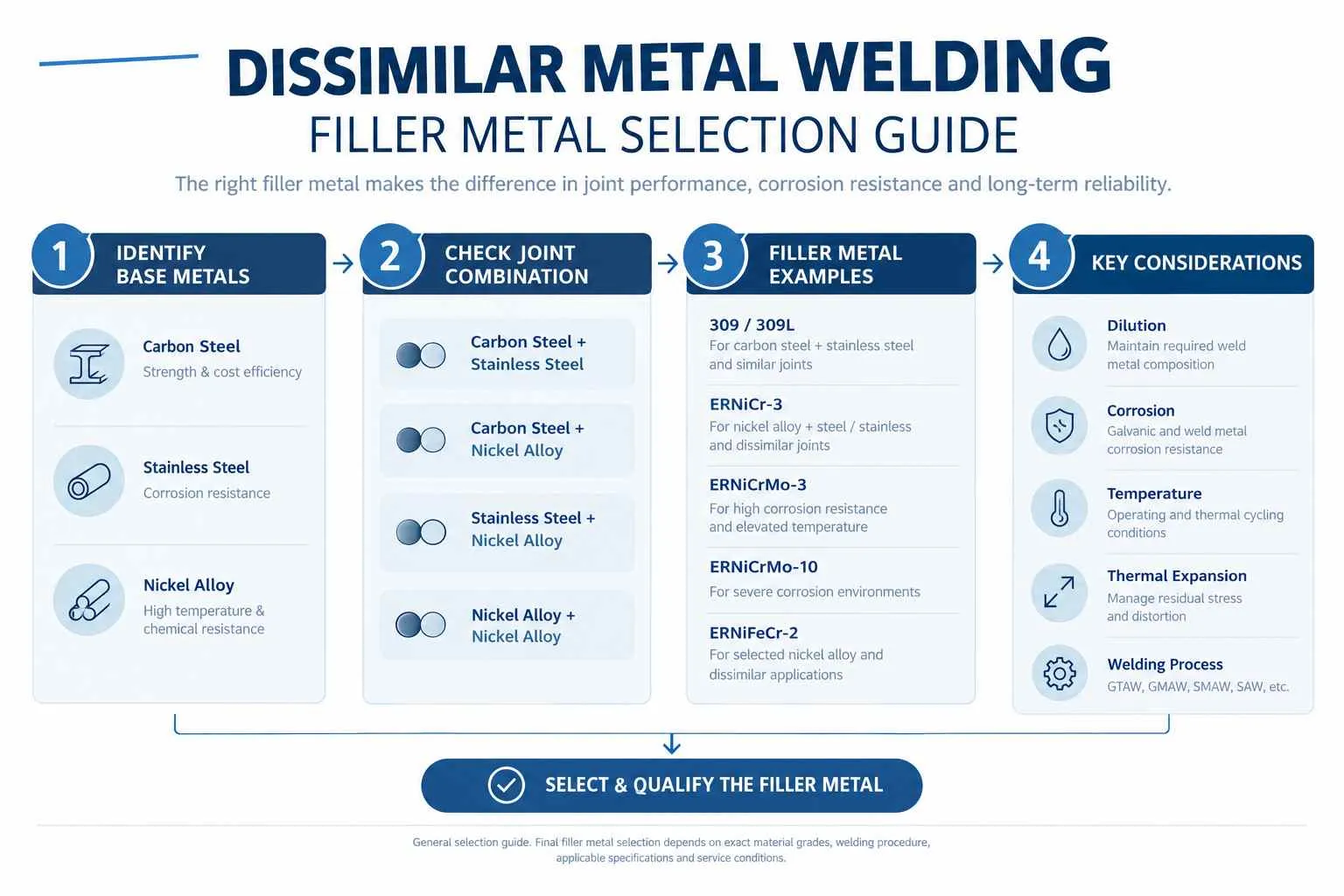
In dissimilar metal joining, both wires are frequently used as alternatives to one another. For example:
Studies have shown that ERNiCrMo‑4 weldments exhibit superior impact toughness at both ambient and sub‑zero temperatures compared to ERNiCrMo‑10. In applications demanding high toughness, ERNiCrMo‑4 may therefore hold an edge.
| Consideration | Recommend ERNiCrMo‑4 | Recommend ERNiCrMo‑10 |
|---|---|---|
| Service medium | Strongly reducing acids (HCl, H₂SO₄) | Oxidizing + reducing, complex media |
| Base metal match | C‑276 alloy | C‑22 alloy |
| Pitting resistance requirement | Extremely high | High |
| Thermal stability requirement | Moderate | Higher |
| Dissimilar welding versatility | As matching filler for C‑276 | As matching filler for C‑22 |
ERNiCrMo-4 and ERNiCrMo-10 are both high-performance nickel-alloy filler metals, but they are designed for different service conditions.
In practice, filler metal selection should be based on the base alloy, service environment, and project requirements. Choosing the correct ERNiCrMo filler wire helps ensure reliable weld performance and long-term corrosion resistance.
1. Can ERNiCrMo-10 replace ERNiCrMo-4?
In some applications, ERNiCrMo-10 can be used as an alternative filler metal, especially when broader corrosion resistance is required. However, for Hastelloy C-276 base materials or specifications requiring ERNiCrMo-4 classification, ERNiCrMo-4 remains the preferred choice.
2. What is the difference between ERNiCrMo-4 and ERNiCrMo-10?
The main difference is their alloy balance. ERNiCrMo-4 contains higher molybdenum and tungsten content for superior performance in strongly reducing environments, while ERNiCrMo-10 contains higher chromium content for improved resistance in oxidizing and mixed corrosion conditions.
3. Is ERNiCrMo-4 the same as Hastelloy C-276 welding wire?
Yes. ERNiCrMo-4 is the AWS A5.14 filler metal classification commonly used for welding Hastelloy C-276 and is often referred to as C-276 welding wire.
4. Is ERNiCrMo-10 the same as Alloy 22 welding wire?
Yes. ERNiCrMo-10 corresponds to Hastelloy C-22 and is commonly known as Alloy 22 welding wire or C-22 filler wire.
5. Which filler wire should I choose: ERNiCrMo-4 or ERNiCrMo-10?
The selection depends on the base metal and service environment:
Ronsco is a trusted global supplier of nickel alloy and stainless steel welding wires, including Inconel, Hastelloy, and Monel series. Our products are manufactured to meet industry standards and are widely used in demanding applications such as aerospace, oil & gas, chemical processing, and power generation. Explore our resource center for the latest industry insights, product knowledge, and technical references.
Contact us for a quote or technical assistance.


 English
 Español
 русский язык
 اللغة العربية