

What Is the Best Filler Metal for 17-4PH Stainless Steel?
The best filler metal for 17-4PH stainless steel is usually AWS A5.9 ER630 (UNS S17480), because it provides the closest match in strength, corrosion resistance, and precipitation-hardening response to the 17-4PH base metal.
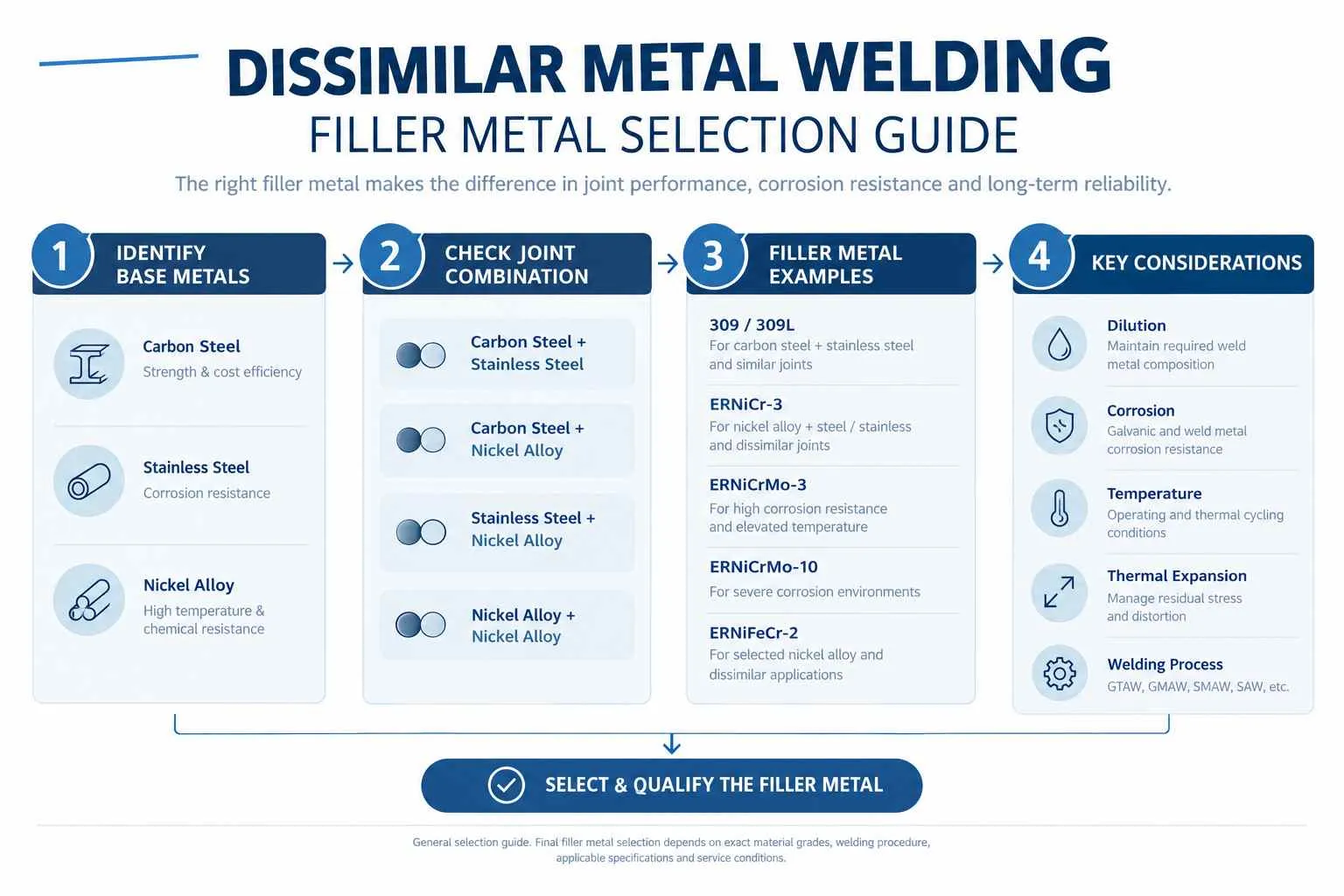
However, ER630 is not always the ideal choice for every welding scenario. For dissimilar welding between 17-4PH and austenitic stainless steels such as 304L or 316L, filler metals like 309L or 312L are often preferred. In low-strength or non-heat-treated applications, 308L may also be used as a cost-effective alternative.
In this guide, we compare ER630, 308L, 309L, 312L, and nickel-based fillers for 17-4PH welding, including strength, corrosion resistance, welding performance, PWHT requirements, and best-use scenarios.
When welded joints must maintain similar strength and precipitation-hardening capability as the base metal, ER630 welding wire is generally considered the best filler metal for 17-4PH stainless steel.
It is specifically designed for welding precipitation-hardening stainless steels such as 17-4PH (ASTM A564 Type 630). After proper post-weld heat treatment, ER630 weld metal can achieve mechanical properties close to the base material, making it the preferred choice for aerospace, petrochemical, marine, valve, and high-strength industrial applications.
Typical chemical composition:
| Element | Content |
| Cr | 16.0–16.75% |
| Ni | 4.5–5.0% |
| Cu | 3.25–4.00% |
| Nb + Ta | 0.15–0.30% |
| C | ≤0.05% |
After GTAW welding with ER630 filler metal, the weld metal can achieve:
After proper aging treatment such as H900, the strength can approach the level of 17-4PH base metal.
Because ER630 matches the chemistry of 17-4PH stainless steel, it maintains excellent corrosion resistance in:
Unlike austenitic fillers such as 308L, ER630 responds well to precipitation-hardening heat treatment, which is critical for high-strength structural applications.
Compared with high-nickel filler metals, ER630 offers a better balance between performance and welding cost.
Choosing the correct filler metal depends heavily on service conditions and mechanical requirements.
| Filler Metal | Type | Strength Level | PWHT Response | Typical Application |
| ER630 | Matching PH stainless | Very high | Excellent | High-strength same-material welding |
| 308L | Austenitic stainless | Low | None | Non-critical welds |
| 309L | Dissimilar stainless | Medium | Limited | 17-4PH to 304L/316L |
| 312L | Crack-resistant stainless | Medium-high | Limited | Difficult dissimilar welding |
| Nickel-based fillers | Ni alloy | Varies | Varies | Extreme corrosion or special applications |
Yes, 308L can weld 17-4PH stainless steel, but it is usually not recommended for critical high-strength applications.
The main limitation of 308L is that it does not provide precipitation hardening. As a result:
308L is mainly suitable for:
If the joint requires mechanical properties close to 17-4PH base metal, ER630 remains the preferred filler metal.
Dissimilar welding between 17-4PH and austenitic stainless steels such as 304L or 316L requires special consideration.
In these applications, using ER630 directly is often not ideal because dilution effects may increase cracking risk or create undesirable weld microstructures.
For dissimilar welding, most welding engineers prefer 309L and 312L. These fillers provide better crack resistance, more stable weld metallurgy, and improved tolerance to dilution.
Typical applications include:
For GTAW applications, the best TIG wire for 17-4PH is generally ER630 welding wire.
Typical GTAW parameters for ER630:
| Parameter | Recommended Range |
| Current | DC 130–150 A |
| Voltage | 18–20 V |
| Shielding Gas | 100% Argon |
| Interpass Temperature | Below 150°C (300°F) |
To improve weld quality:
Preheat and Interpass Temperature
17-4PH usually does not require preheating. However, for thick sections above 4 inches, moderate preheat may help reduce cracking risk.
Recommended interpass temperature:
Hydrogen Control
Because martensitic structures are sensitive to hydrogen cracking:
Preventing Porosity
If porosity occurs:
For high-strength applications, PWHT is one of the most important steps in the entire welding process.
The standard practice is direct aging treatment after welding:
Benefits of proper PWHT:
Without PWHT, the weld cannot fully achieve the mechanical potential of 17-4PH stainless steel.
1. What is the best filler metal for 17-4PH stainless steel?
AWS A5.9 ER630 is generally considered the best filler metal for 17-4PH because it closely matches the base metal chemistry and precipitation-hardening behavior.
2. Is ER630 required for 17-4PH welding?
Not always. ER630 is preferred for high-strength applications, but 308L, 309L, or 312L may be used in non-critical or dissimilar welding applications.
3. Can ER308L weld 17-4PH?
Yes, but the weld strength will be much lower than the 17-4PH base material.
4. What is the best TIG wire for 17-4PH?
ER630 TIG wire is typically the best choice for GTAW welding of 17-4PH stainless steel.
5. Does 17-4PH require post-weld heat treatment?
For critical structural or high-strength applications, PWHT is strongly recommended.
Ronsco supply high-quality ER630 welding wire for aerospace, petrochemical, marine, valve, pump, and high-strength stainless steel applications.
Available Forms:
Ronsco is a trusted global supplier of nickel alloy and stainless steel welding wires, including Inconel, Hastelloy, and Monel series. Our products are manufactured to meet industry standards and are widely used in demanding applications such as aerospace, oil & gas, chemical processing, and power generation. Explore our resource center for the latest industry insights, product knowledge, and technical references.
Contact us for a quote or technical assistance.


 English
 Español
 русский язык
 اللغة العربية