

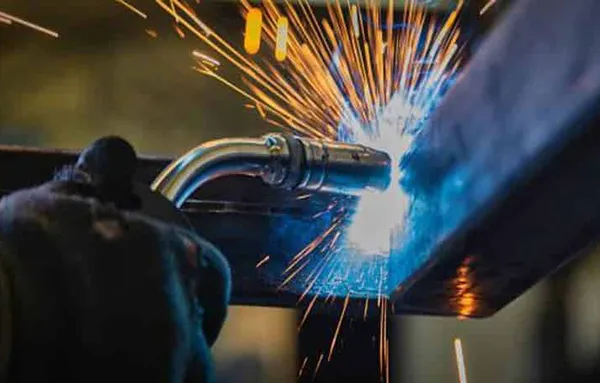
When it comes to gas metal arc welding (GMAW) and gas tungsten arc welding (GTAW) of carbon steel, two filler metal specifications dominate the market: ER70S-2 and ER70S-6.
If you’ve ever stood in front of a welding supply shelf wondering which wire to pick, you are not alone. While both wires fall under the “ER70S” classification indicating a minimum tensile strength of 70,000 psi and a solid wire suitable for steel,their chemical compositions and deoxidizer packages are vastly different.
Choosing the wrong one can lead to porosity, cracking, or unnecessary cleanup costs. In this guide, we will break down the differences between ER70S-2 and ER70S-6, their ideal applications, and how to select the best wire for your project.
Before diving into the differences, let’s decode the nomenclature:
The final number -2 or -6 indicates the chemical composition and the type of deoxidizers present in the wire.
The primary difference between these two wires lies in their deoxidizer content. Deoxidizers are elements added to the wire to prevent oxidation and porosity in the weld puddle.
ER70S-2 is often referred to as the “triple deoxidizer” wire. It contains small but effective amounts of:
Zirconium (Zr)
Titanium (Ti)
Aluminum (Al)
These three elements are extremely aggressive in scavenging oxygen, nitrogen, and other impurities from the base metal.
ER70S-6 contains higher levels of Manganese (Mn) and Silicon (Si) compared to ER70S-2.
Manganese: 1.4% – 1.6%
Silicon: 0.8% – 1.0%
This high silicon content allows the weld puddle to flow more easily (increased wetting action) and produces a flatter, smoother bead profile.
| Feature | ER70S-2 | ER70S-6 |
| Key Deoxidizers | Al, Ti, Zr | High Mn & High Si |
| Base Metal Tolerance | Excellent for dirty, rusty, or mill-scaled steel | Good for clean steel; moderate tolerance to light rust |
| Bead Appearance | Smooth, but requires good technique | Flatter, smoother, with excellent wetting action |
| Porosity Resistance | Superior resistance on contaminated materials | Standard resistance; requires cleaner base metal |
| Cost | Slightly higher due to exotic deoxidizers | Generally more affordable |
Selecting the right wire depends entirely on the condition of your base metal, the welding process, and the required mechanical properties.
ER70S-2 is the best choice when you cannot guarantee perfect cleanliness.
Because of its aggressive triple deoxidizers, ER70S-2 can handle:
Rusty or corroded steel
Steel with heavy mill scale
Small amounts of oil or moisture
Poor fit-up conditions
It is the go-to wire for pipe welding (root passes on dirty pipe) and repair work. Additionally, because it has lower silicon content, it is often preferred when the weld will be painted or galvanized after welding, as it minimizes the risk of silicon island adhesion issues.
Best for: Pipeline root passes, heavy fabrication, repair welding, and situations where sandblasting or pre-cleaning is impractical.
ER70S-6 is the industry workhorse for clean, high-production welding.
If your material is new, clean, or has been properly prepared (ground or blasted), ER70S-6 offers superior productivity.
Faster travel speeds due to improved wetting.
Smoother bead appearance—ideal for cosmetic welds.
Fewer cold lap issues in robotic or automated welding.
However, caution is needed. The high silicon content in ER70S-6 leaves a silica island on the surface of the weld. While this is easily chipped away, it must be removed before painting, otherwise the paint may peel or fail over time.
Best for: Automotive fabrication, structural steel (clean), manufacturing, and robotic welding applications.
To help visualize which wire fits your job, here are three common scenarios:
Recommendation: ER70S-6
Reason: The smooth wetting action prevents undercutting on thin materials, and the base metal is typically new and clean.
Recommendation: ER70S-2
Reason: Mill scale is notorious for causing porosity. The aggressive deoxidizers in ER70S-2 cut through the scale that remains even after wire brushing.
Recommendation: ER70S-2
Reason: In pipe welding, the root pass is critical. ER70S-2 provides the “forgiveness” needed if there is slight contamination or poor purge gas coverage.
From a mechanical standpoint, both wires produce welds meeting the required 70,000 psi tensile strength. In many structural applications, they are considered functionally interchangeable if the base metal is clean.
However, if you are working to a Welding Procedure Specification, you must use the wire specified. You cannot substitute ER70S-6 for ER70S-2 on a qualified procedure unless re-qualification is performed, as the chemical composition of the deposited weld metal differs significantly.
While ER70S-2 is slightly more expensive per pound, it can actually save you money in certain applications.
If you use ER70S-2, you spend less time on pre-cleaning (grinding, degreasing) and less money on cleaning solvents.
If you use ER70S-6, you save on wire cost but may incur higher labor costs for pre-cleaning and post-weld grinding (to remove silica deposits before coating).
For large-scale manufacturing with automated systems, the higher travel speeds of ER70S-6 usually win the cost-efficiency battle.
To summarize the ER70S-2 vs ER70S-6 debate:
Pick ER70S-2 if you are dealing with dirty, rusty, or questionable base metals, or if you are performing critical pipe welds. It offers the highest resistance to porosity and is ideal for repair and field work.
Pick ER70S-6 if you are welding new, clean steel in a shop environment, looking for the smoothest bead appearance, or maximizing travel speeds for high-volume production.
Both wires are exceptional. The appropriate choice depends entirely on the cleanliness of your material and the standards required by your project specifications.
Choosing the correct filler metal is just the first step. Whether you require ER70S-2 for your critical pipeline projects or ER70S-6 for high-speed manufacturing, ensuring a reliable supply chain and consistent quality is essential.
We specialize in providing premium-grade welding consumables tailored to your specific application needs. If you are unsure which wire fits your current base metal condition or need a custom packaging solution, we are here to help.
📞 Contact us today to get a quote or speak with our experts. Let us help you optimize your welding processes while reducing rework costs.
Ronsco is a trusted global supplier of nickel alloy and stainless steel welding wires, including Inconel, Hastelloy, and Monel series. Our products are manufactured to meet industry standards and are widely used in demanding applications such as aerospace, oil & gas, chemical processing, and power generation. Explore our resource center for the latest industry insights, product knowledge, and technical references.
Contact us for a quote or technical assistance.


 English
 Español
 русский язык
 اللغة العربية