

Choosing between solid wire and flux cored wire is one of the most important decisions in any welding project. The right filler metal affects far more than weld appearance. It influences productivity, welding efficiency, rework rates, equipment requirements, and ultimately the total fabrication cost.
Many welders assume that flux cored wire is always stronger because it produces deeper penetration, while others believe solid wire is the better option because it creates cleaner welds. In reality, neither assumption is universally correct. The best choice depends on the material being welded, the service environment, joint design, welding position, and whether portability or productivity is the higher priority.
This guide compares flux cored wire and solid wire from both a technical and purchasing perspective, helping engineers, buyers, and fabricators select the most suitable welding consumable for their application.
Flux cored wire is a tubular welding wire filled with a carefully formulated flux mixture. During welding, the flux performs several important functions:
Flux cored wires are generally divided into two categories.
Self-shielded wires generate their own shielding gas from the flux and do not require an external gas cylinder.
Typical example:
Advantages include:
Gas-shielded FCAW uses both flux and an external shielding gas.
Typical examples include:
Compared with self-shielded wires, gas-shielded flux cored wires generally produce:
They are widely used in heavy fabrication, shipbuilding, pressure vessels, and structural steel manufacturing.
Solid wire is a continuous metal electrode used in Gas Metal Arc Welding (GMAW), commonly known as MIG welding. Unlike flux cored wire, it has a homogeneous metallic structure with no flux inside the wire.
Because it contains no flux, solid wire always requires an external shielding gas to protect the molten weld pool from atmospheric contamination. The most common shielding gases include:
Solid wires are available for almost every engineering material, including:
| Base Material | Common Solid Wire |
|---|---|
| Carbon Steel | ER70S-6 |
| Stainless Steel 304 | ER308L |
| Stainless Steel 316 | ER316L |
| Duplex Stainless Steel | ER2209 |
| Inconel® 600/601 | ERNiCr-3 |
| Inconel® 625 | ERNiCrMo-3 |
| Monel® 400 | ERNiCu-7 |
Because there is no slag-forming flux, solid wire produces smooth weld beads with minimal post-weld cleaning. This makes it the preferred choice for applications where weld appearance, corrosion resistance, or radiographic quality is important.
Although both consumables melt to become part of the weld, they protect the molten weld pool differently.
Protection comes entirely from external shielding gas.
Advantages include:
However, if wind disrupts the shielding gas, porosity can occur quickly.
The flux inside the wire decomposes during welding, producing shielding gases while simultaneously creating a layer of slag over the weld.
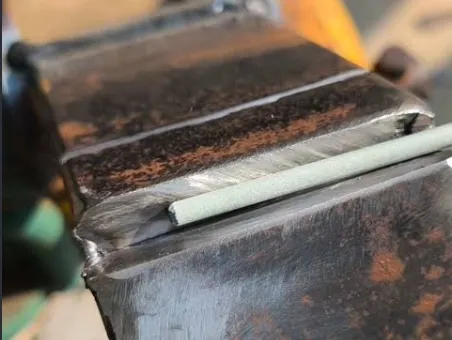
This slag protects the weld during cooling but must be removed after welding.
Because the arc energy is concentrated differently, many flux cored wires also achieve deeper penetration than comparable solid wires, making them particularly effective for thicker sections.
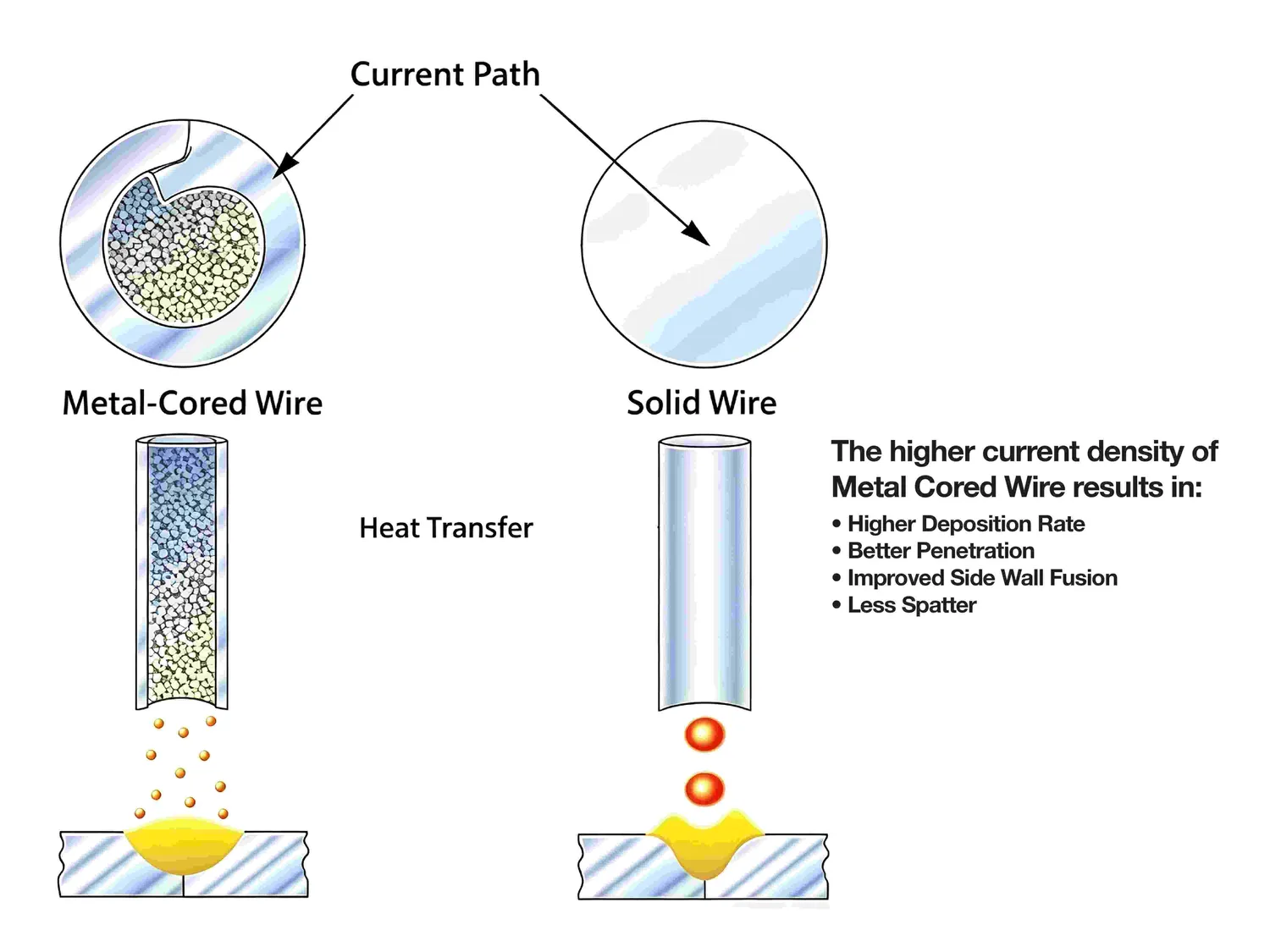
| Feature | Solid Wire | Flux Cored Wire |
|---|---|---|
| Wire Structure | Solid metal | Tubular with flux core |
| Shielding Gas | Always required | Self-shielded or gas-shielded |
| Outdoor Welding | Poor | Excellent |
| Weld Appearance | Excellent | Good |
| Slag | None | Present |
| Post-Weld Cleaning | Minimal | Slag removal required |
| Spatter | Low | Moderate to high |
| Deposition Rate | Moderate | High |
| Penetration | Moderate | Deep |
| Thin Materials | Excellent | Less suitable |
| Thick Materials | Good | Excellent |
| Portability | Limited | Excellent (self-shielded) |
| Automation | Excellent | Good |
The most obvious difference is how each process protects the weld pool.
Solid wire depends entirely on external shielding gas. This produces a clean weld with virtually no slag but makes the process sensitive to wind.
Flux cored wire relies on the chemical reactions inside the flux. Self-shielded wires require no gas at all, while gas-shielded wires combine both shielding methods for enhanced performance.
For outdoor construction or pipeline maintenance, this difference alone often determines the choice.
If cosmetic appearance is important, solid wire has a clear advantage.
Because no slag forms during welding, the finished weld usually requires little more than light brushing before painting or further processing.
Flux cored welds typically leave slag that must be removed. Although modern gas-shielded flux cored wires produce attractive weld beads, additional cleaning is still required before inspection or multi-pass welding.
For industries such as food processing, pharmaceutical equipment, or architectural stainless steel, solid wire is generally preferred because cleaner welds help preserve both appearance and corrosion resistance.
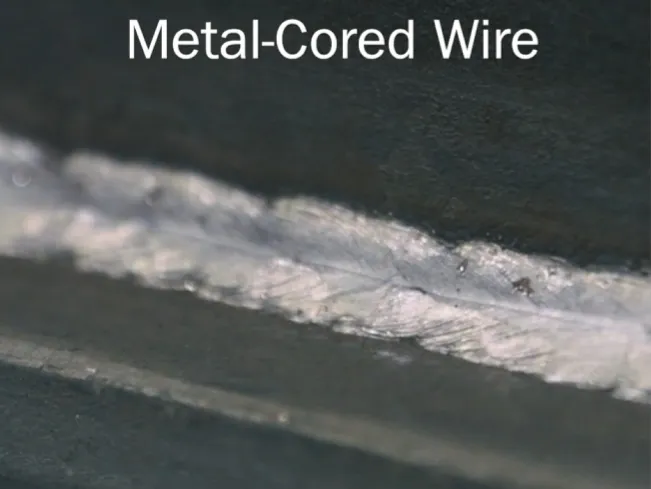
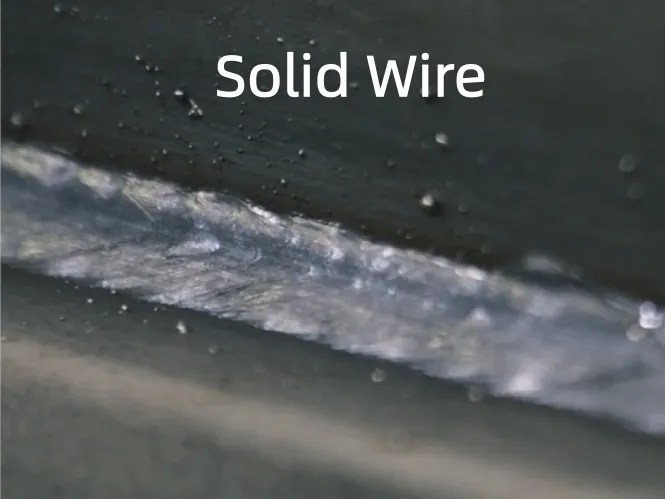
One reason flux cored wire is widely used in structural fabrication is its ability to produce deeper penetration.
The concentrated arc and slag system make it easier to achieve full fusion on thicker materials, especially when welding in vertical or overhead positions.
However, deeper penetration does not automatically mean a stronger weld.
Joint design, welding procedure, filler metal classification, heat input, and welding technique all have a significant influence on final weld strength.
For most qualified welding procedures, both solid wire and flux cored wire can achieve the mechanical properties required by applicable codes.
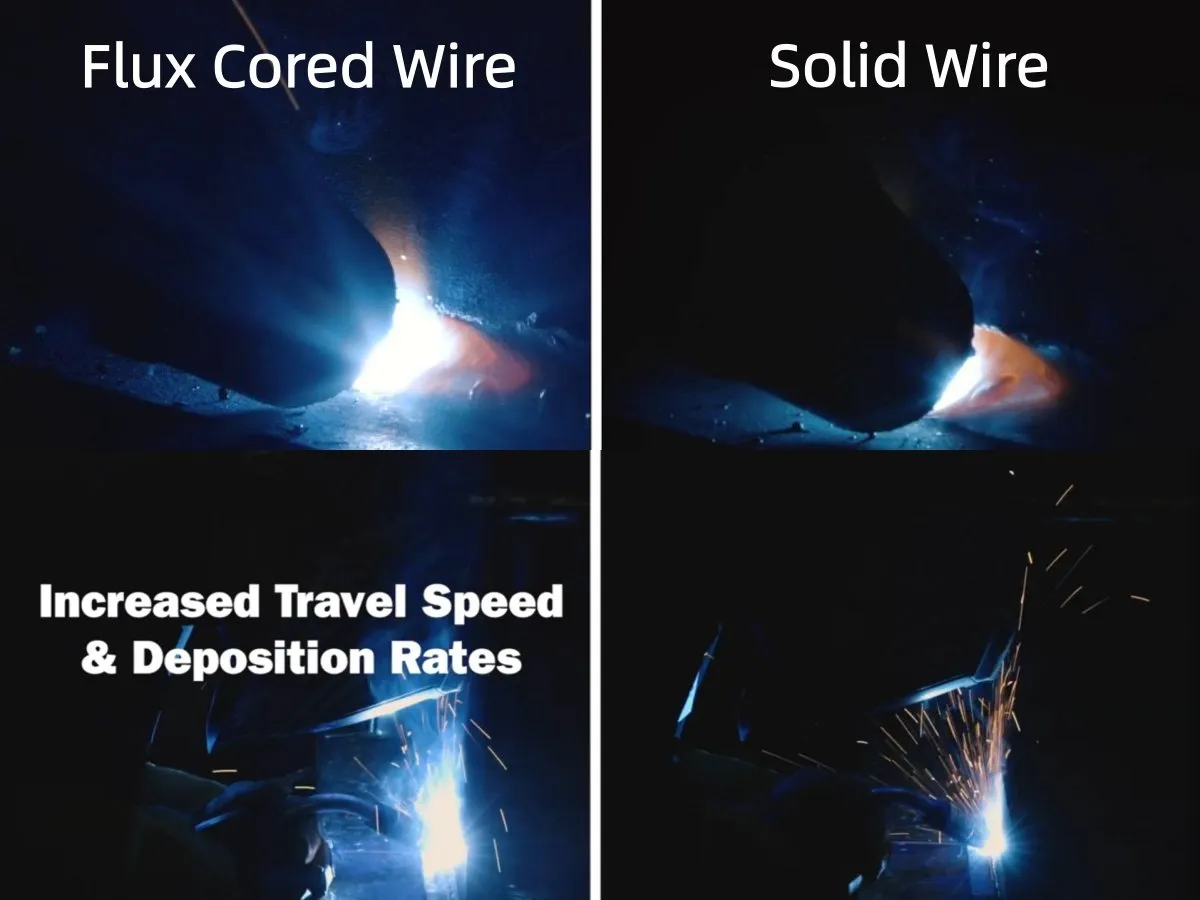
Productivity is where flux cored wire often demonstrates its greatest advantage.
Its higher deposition rate allows more weld metal to be deposited in less time, making it an excellent choice for:
When welding long seams on thick carbon steel plates, the productivity gains can significantly reduce labor costs.
However, productivity should always be evaluated together with post-weld cleaning and inspection requirements. In applications where weld quality is critical, faster deposition may not necessarily result in lower overall fabrication costs.
Many buyers compare only the price per kilogram of welding wire.
In reality, the total welding cost includes much more than the consumable itself.
Factors such as shielding gas consumption, labor time, slag removal, grinding, rework, and production efficiency often have a much greater impact on project cost than the wire price alone.
For example, flux cored wire is generally more expensive per kilogram than solid wire. However, its higher deposition rate may reduce labor hours on large structural projects.
Conversely, in stainless steel or nickel alloy fabrication, where weld quality and corrosion resistance are critical, the additional cleaning associated with flux cored wire may outweigh any productivity advantage.
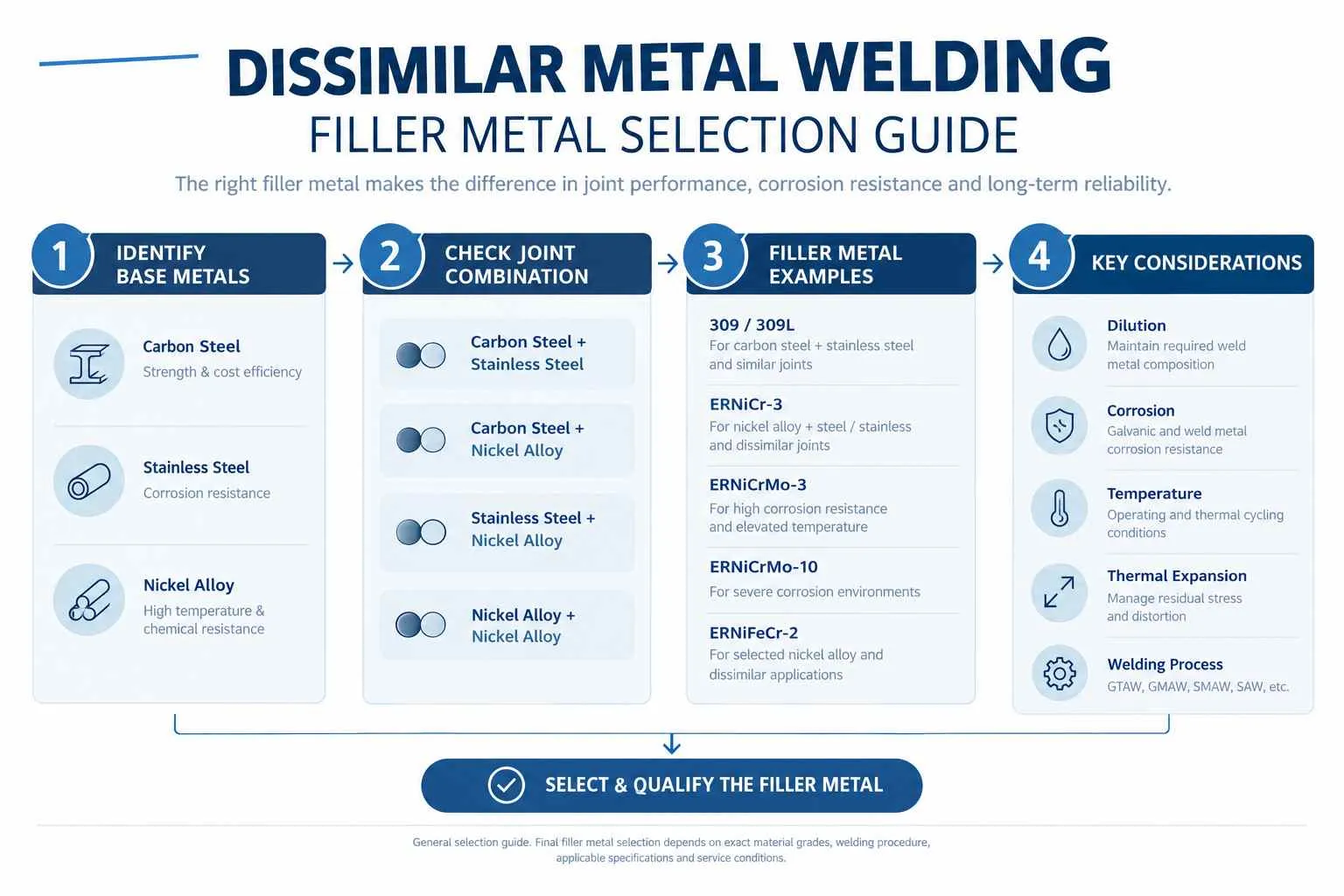
For high-value alloys such as ERNiCr-3, ERNiCrMo-3, or ERNiCu-7, the filler metal cost is often only a small percentage of the total fabrication cost. In these applications, minimizing weld defects and avoiding costly repairs is usually more important than maximizing deposition rate.
This is one of the biggest differences between general carbon steel fabrication and high-performance alloy welding.
For structural carbon steel, maximizing deposition rate is often the primary objective.
For stainless steel and nickel alloy fabrication, however, weld quality usually becomes the highest priority.
Consider applications such as:
In these industries, repair costs can be several times higher than the cost of the welding consumables themselves. A single weld defect may require grinding, gouging, re-welding, re-inspection, additional NDT or production delays.
Consequently, fabricators often prioritize welding processes that minimize the risk of slag inclusions and simplify inspection.
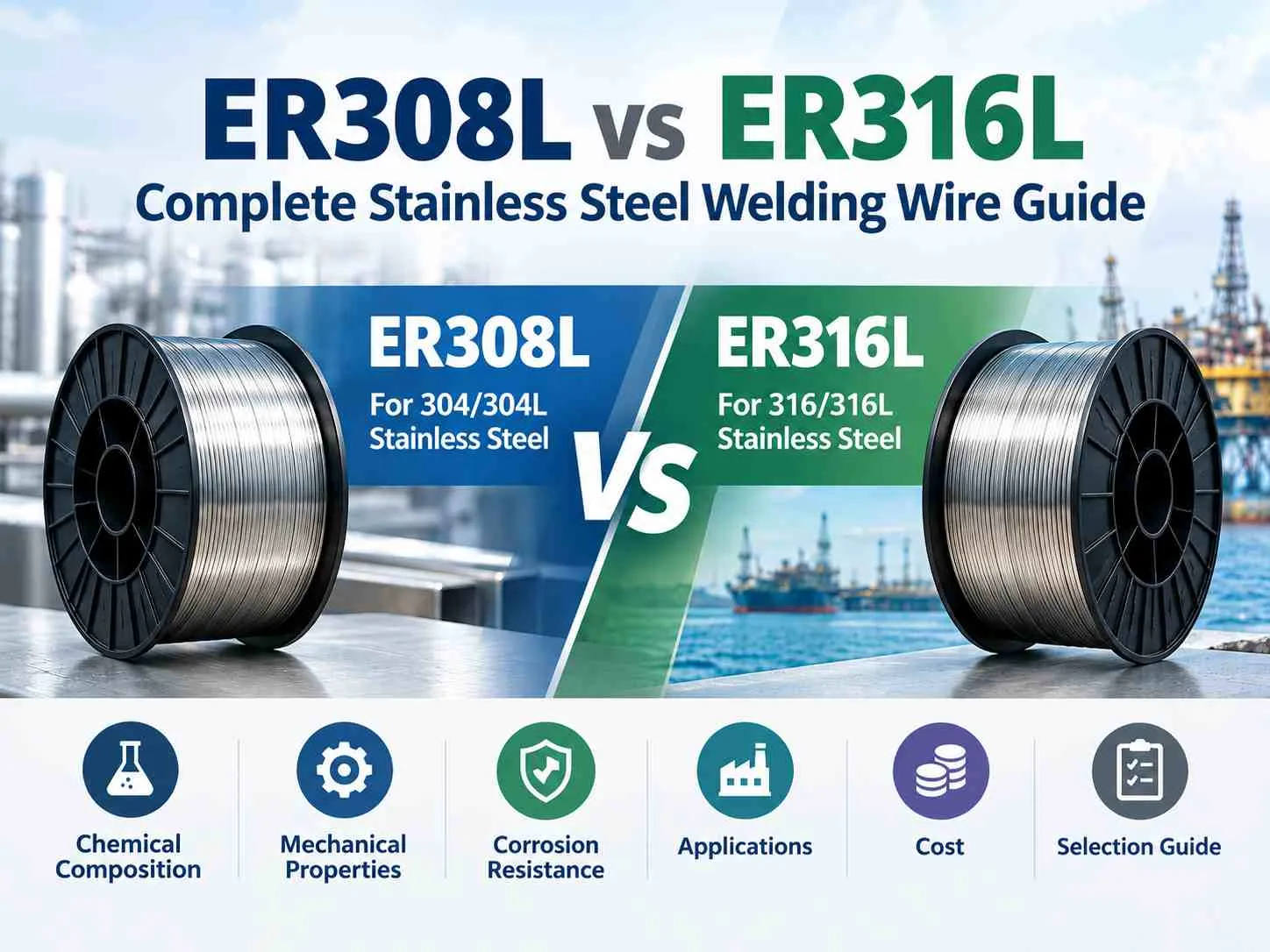
This explains why solid wires such as ER308L, ER316L, ER2209, ERNiCr-3, ERNiCrMo-3, and ERNiCu-7 remain the preferred choice for many corrosion-resistant applications.
Although stainless steel and nickel alloy flux cored wires are available and are widely used in heavy fabrication, solid wire continues to dominate applications where weld cleanliness, corrosion resistance, and inspection reliability are critical.
Understanding these frequent missteps can save your project from costly delays:
The cheapest spool often leads to the most expensive rework. Always calculate cost per acceptable weld.
Deep penetration is not a substitute for proper joint design and qualified procedures.
Using solid wire outdoors without proper wind shielding is a recipe for porosity.
For corrosion-resistant alloys, weld purity and corrosion resistance far outweigh deposition speed.
Switching between wire types often requires reversing polarity (DCEN vs. DCEP) – failing to do so ruins weld quality.
Flux cored wire is softer; excessive tension deforms it and causes feeding issues.
Slag left on stainless or nickel alloys can initiate crevice corrosion, defeating the purpose of using expensive alloys.
1. Is solid wire better than flux cored wire?
Neither is universally better. Solid wire is ideal for clean indoor fabrication, thin materials, and corrosion-resistant alloys. Flux cored wire excels in outdoor environments, thick sections, and high-productivity structural welding.
2. Can flux cored wire be used on stainless steel?
Yes. Stainless steel flux cored wires such as E308LT1 and E316LT1 are widely used in heavy fabrication and industrial applications.
3. Can nickel alloys be welded with flux cored wire?
Yes, flux cored nickel alloy consumables are available for certain applications. However, solid wires remain more common where corrosion resistance, weld cleanliness, and inspection quality are critical.
4. Which process is easier for beginners?
Solid wire is generally easier to learn because the weld pool is easier to see and there is no slag to remove.
5. Which process produces less spatter?
Solid wire usually produces significantly less spatter than flux cored wire.
6. Which wire is better for outdoor welding?
Self-shielded flux cored wire is specifically designed for outdoor environments and windy conditions.
7. Can I switch from flux cored wire to solid wire?
Yes, provided your welding machine supports both processes. You may need to change polarity, shielding gas, drive rolls, and welding parameters.
8. Is solid wire always cheaper?
Solid wire usually costs less per kilogram. However, total welding cost should include labor, shielding gas, productivity, cleaning, and rework.
9. Which process is better for robotic welding?
Solid wire is generally preferred because of its stable wire feeding, consistent arc characteristics, and clean welds.
The comparison between solid wire and flux cored wire is not about determining which process is universally better.
For carbon steel structural fabrication, flux cored wire often offers outstanding productivity, deep penetration, and excellent performance in outdoor environments.
For stainless steel fabrication, pressure equipment, and many nickel alloy applications, solid wire continues to be the preferred choice due to its cleaner welds, reduced post-weld cleaning, and superior suitability for corrosion-resistant service.
Instead of comparing wire price alone, fabricators should evaluate the complete welding process, including productivity, inspection requirements, repair costs, and long-term service performance. In many industrial projects, the most economical choice is not the least expensive consumable, but the one that delivers the highest overall welding quality with the lowest risk of rework.
Ronsco is an experienced welding wire manufacturer and supplier. We supplies a comprehensive range of solid welding wires and flux cored wires, including grades for nickel alloys and stainless steel. You can check our main product list here. Besides, if you also require nickel alloy or stainless steel products in other forms, such as plates, coils, pipes, or bars, please feel free to contact us.
Email us: support@ronsteel.com
Whatsapp: +8617773160488
Ronsco is a trusted global supplier of nickel alloy and stainless steel welding wires, including Inconel, Hastelloy, and Monel series. Our products are manufactured to meet industry standards and are widely used in demanding applications such as aerospace, oil & gas, chemical processing, and power generation. Explore our resource center for the latest industry insights, product knowledge, and technical references.
Contact us for a quote or technical assistance.


 English
 Español
 русский язык
 اللغة العربية