

In pressure vessel fabrication, welding is one of the most critical operations, as these vessels must safely withstand pressures significantly different from ambient conditions. Among all welding consumables, pressure vessel welding wire serves as the fundamental building block of joint integrity. The correct choice and application of filler metal directly determine whether a pressure vessel will operate safely throughout its design life or become a potential hazard.
This article provides a systematic overview of pressure vessel welding wire types, selection principles, code compliance, and practical application cases, with a special focus on stainless and nickel-alloy products for demanding service environments.
Different base materials and service conditions require distinctly different filler metal grades. The table below summarises the main categories and their typical applications:
| Wire Category | Representative Grades | Matching Base Materials | Typical Service Environments |
|---|---|---|---|
| Carbon steel wires | H08A, H08MnA + SJ301 flux | Q235, Q345R | General pressure vessels at moderate temperatures |
| Low-alloy steel wires | H10Mn2, H08MnMoA | Q345R, Q370R | Medium-high pressure vessels requiring higher strength |
| Heat-resistant steel wires | H08CrMoA, H14Cr1MoR | 1Cr-0.5Mo, 1.5Cr-0.5Mo | High-temperature services (e.g., hydroprocessing reactors) |
| Low-temperature steel wires | H09MnNiDR + SJ208DR flux | 09MnNiDR, 06Ni9DR | Cryogenic storage (LNG, etc.) |
| Austenitic stainless steel wires | ER308L, ER316L, ER309L | 304/316 stainless steels and clad plates | Corrosive media (acids, alkalis, seawater) |
| Duplex & super-duplex wires | ER2209, ER2594 | Duplex stainless steels (e.g., 2205, 2507) | Marine pressure vessels, seawater heat exchangers |
| Precipitation-hardening wire | ER630 (17-4PH) | 17-4PH stainless steel | Valve seats, pump shafts, wear-resistant parts |
| Nickel-alloy wires | ERNiCrMo-3 (625), ERNiCrMo-4 (C-276) | Nickel alloys, dissimilar joints | Severe corrosion + high temperature, LNG cryogenic service |
| Titanium wires | ERTi-2 | Commercial pure titanium | Chemical heat exchangers, corrosion-resistant equipment |
There is no single welding wire suitable for all pressure vessels. The filler metal should be selected according to the base-metal grade, welding process, design temperature, service medium, required mechanical properties, and applicable welding code.
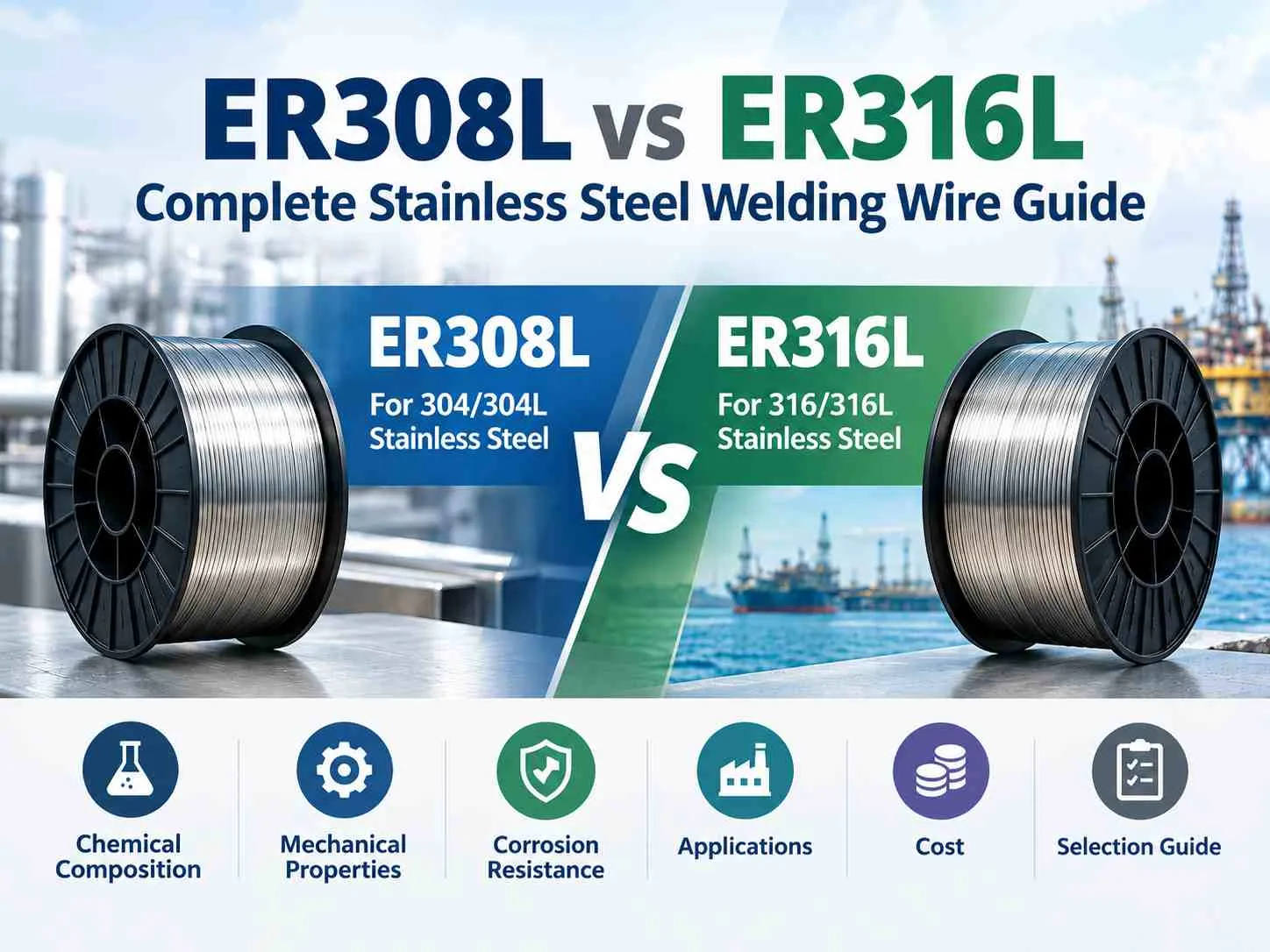
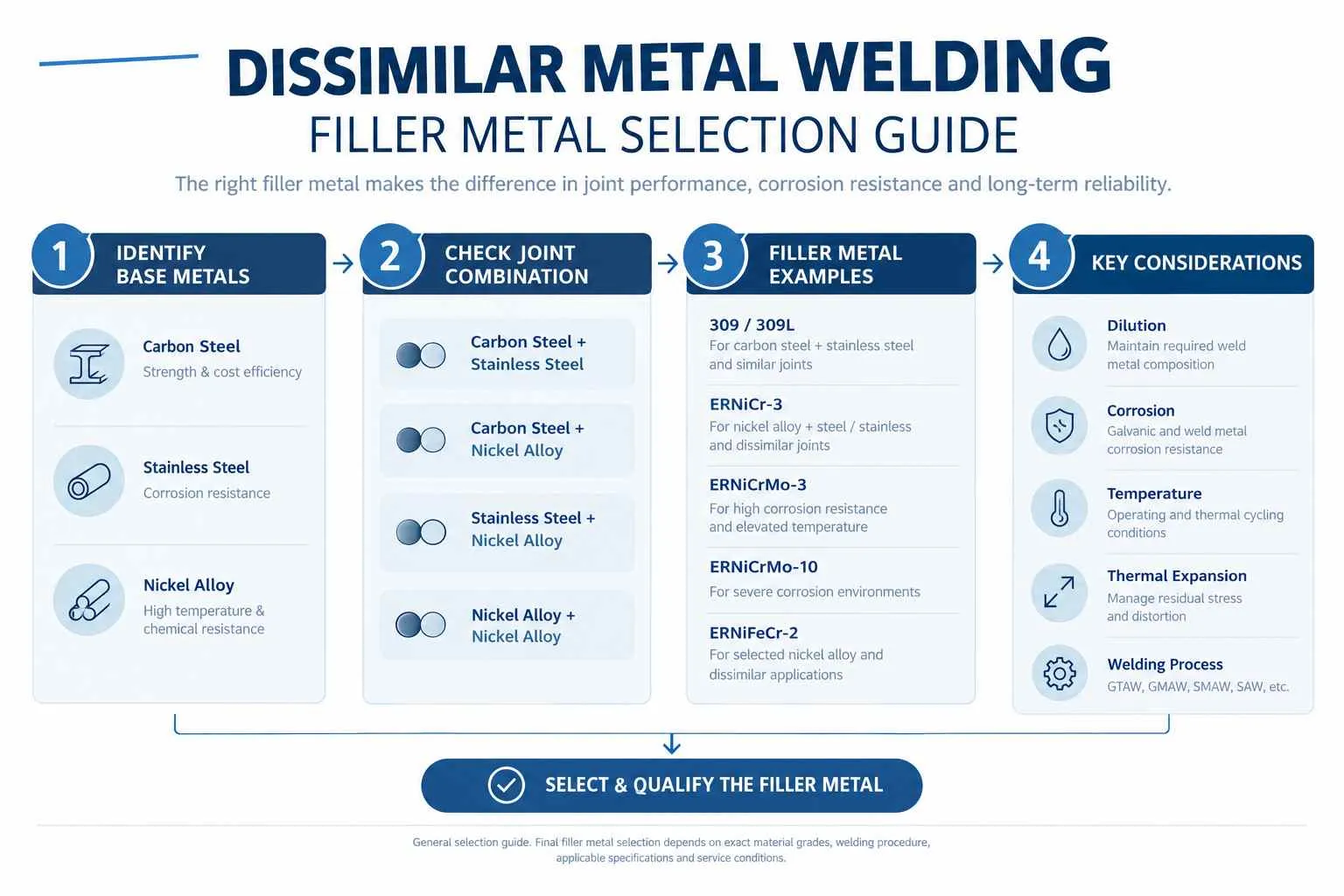
For example, ER308L is commonly selected for 304/304L stainless steel, ER316L for 316/316L stainless steel, ER309L for many stainless-steel-to-carbon-steel dissimilar joints, ER2209 for 2205 duplex stainless steel, ER2594 for super duplex applications, and ERNiCrMo-series wires for demanding nickel alloy and cryogenic applications. The final filler metal selection should always be verified against the qualified welding procedure and applicable project requirements.
Selecting the right welding wire is not merely about matching strength grades. It involves three essential levels of compatibility:
In China, pressure equipment welding is primarily governed by the NB/T 47018 series for welding consumables and NB/T 47014-2023 for welding procedure qualification. The applicable edition should be confirmed according to the specific project and procurement requirements.
The NB/T 47018 series covers technical requirements for pressure-equipment welding consumables, including submerged-arc welding wires and fluxes, as well as solid wires and filler rods for gas-shielded arc welding. NB/T 47014-2023 defines the requirements for welding procedure qualification and directly affects filler-metal selection and welding procedure development.
For international projects, ASME Section II, Part C and its SFA specifications, such as SFA-5.18 and SFA-5.28, are also commonly referenced. Applicable standards and editions should be confirmed before procurement and welding procedure qualification.
| Material / Wire | Common Specification |
| ER308L / ER316L / ER309L | AWS A5.9 / ASME SFA-5.9 |
| ER2209 / ER2594 | AWS A5.9 / applicable ASME SFA specification |
| ER630 | AWS A5.9 / ASME SFA-5.9 |
| ERNiCrMo-3 | AWS A5.14 / ASME SFA-5.14 |
| ERNiCrMo-4 | AWS A5.14 / ASME SFA-5.14 |
| ER70S-series | AWS A5.18 / ASME SFA-5.18 |
| Low-alloy steel GMAW wires | AWS A5.28 / ASME SFA-5.28 |
Relevant editions of AWS, ASME, and NB/T standards should be confirmed before procurement, welding procedure qualification, and final project approval.
| Equipment Type | Base Material | Recommended Welding Wire | Key Control Points |
| Q345R medium-pressure storage tank (ambient) | Q345R | H10Mn2 (SAW) + SJ101 flux | Interpass temperature ≤200°C to avoid grain coarsening |
| Hydroprocessing reactor (high-temperature hydrogen) | 2.25Cr-1Mo | H08CrMoV + matching basic flux | Diffusible hydrogen control; post-weld heat treatment according to the qualified procedure |
| LNG cryogenic tank (–165°C) | 06Ni9DR / 9% Ni steel | ERNiCrMo-3 or another qualified Ni-based filler | Cryogenic impact toughness, cleanliness, and qualified welding procedure |
| Stainless-clad reactor (corrosion-resistant lining) | Q345R + 316L cladding | ER309L for buttering, ER316L for face layer | Weld carbon steel substrate first, then cladding; control dilution rate carefully |
| Base Material / Service | Recommended Wire | Key Consideration |
|---|---|---|
| 304/304L | ER308L | Low-carbon stainless filler |
| 316/316L | ER316L | Mo-bearing corrosion resistance |
| Stainless to carbon steel | ER309L | Dissimilar-metal welding |
| Duplex 2205 | ER2209 | Phase balance and corrosion resistance |
| Super duplex 2507 | ER2594 | Chloride corrosion resistance |
| 17-4PH | ER630 | Precipitation hardening |
| 9% Ni steel | ERNiCrMo-3 | Cryogenic service |
| C-276 | ERNiCrMo-4 | Severe corrosion |
We supply stainless steel and nickel alloy welding wires for pressure vessel fabrication, including ER308L, ER309L, ER316L, ER2209, ER2594, ER630, ERNiCrMo-3, and ERNiCrMo-4.
Products are available in common diameters and can be supplied with material certificates, chemical composition and mechanical property documentation, and project-specific packaging or sizing requirements.
For pressure vessel projects, we can provide product data sheets, MTCs, specifications, stock information, and quotations based on the required filler metal grade, diameter, quantity, and applicable standard.
📧 Email: support@ronsteel.com
1. What welding wire is used for pressure vessels?
There is no universal pressure vessel welding wire. Selection depends on the base material, service conditions, welding process, and applicable code.
2. How do I select welding wire for a pressure vessel?
Consider the base-metal grade, design temperature, service medium, mechanical requirements, welding process, and heat-treatment requirements. The final selection should be confirmed through the applicable WPS/PQR.
3. What is the difference between ER308L, ER316L, and ER309L?
ER308L is commonly used for 304/304L stainless steel, ER316L for 316/316L, and ER309L is widely used for dissimilar-metal welding, such as stainless steel to carbon steel.
4. What welding wire is used for duplex pressure vessels?
ER2209 is commonly used for 2205 duplex stainless steel, while ER2594 is used for super-duplex stainless steels such as 2507. The welding procedure should control heat input and weld-metal phase balance.
5. What filler wire is used for 9% Ni LNG tanks?
ERNiCrMo-3 is widely used for welding 9% Ni steel in LNG storage applications. The final filler-metal selection should follow the qualified welding procedure and project requirements.
Ronsco is a trusted global supplier of nickel alloy and stainless steel welding wires, including Inconel, Hastelloy, and Monel series. Our products are manufactured to meet industry standards and are widely used in demanding applications such as aerospace, oil & gas, chemical processing, and power generation. Explore our resource center for the latest industry insights, product knowledge, and technical references.
Contact us for a quote or technical assistance.


 English
 Español
 русский язык
 اللغة العربية