

If you work in aerospace, power generation, or automotive turbocharger manufacturing, you know the name Inconel 713C. This cast nickel-chromium superalloy is legendary for its ability to withstand extreme temperatures, up to 950°C (1742°F) and beyond. But here’s the challenge that keeps engineers up at night: Inconel 713C is notoriously difficult to weld.
That’s where choosing the right Inconel 713C filler wire makes all the difference. At Ronsco, we specialize in high-performance filler metals for demanding applications. In this comprehensive guide, we’ll cover everything you need to know about welding Inconel 713C, from material fundamentals and welding challenges to filler wire selection, best practices, and how Ronsco can help you achieve flawless, crack-free welds.
Inconel 713C (UNS N07713, equivalent to China’s K418/GH4413) is aprecipitation-hardening nickel-chromium superalloydesigned specifically for investment casting. Unlike wrought alloys like Inconel 625 or Inconel 718, 713C is built to becast directly into final shapes, making it ideal for complex hot-section components.
The performance of Inconel 713C comes from its carefully balanced chemistry. Here is the typical chemical composition (wt.%) based on AMS 5381 standards:
| Element | Content (wt.%) | Function |
|---|---|---|
| Nickel (Ni) | Balance (~70–75%) | Matrix element; provides high-temperature stability |
| Chromium (Cr) | 11.0–14.0% | Oxidation and corrosion resistance |
| Aluminum (Al) | 5.5–6.5% | Primary γ′ former for precipitation strengthening |
| Molybdenum (Mo) | 3.5–5.0% | Solid-solution strengthening; enhances creep resistance |
| Niobium (Nb) | 1.5–2.5% | Carbide formation; supplementary strengthening |
| Titanium (Ti) | 0.4–1.0% | γ′ phase stability |
| Carbon (C) | 0.08–0.18% | Forms carbides for high-temperature strength |
| Zirconium (Zr) | 0.05–0.15% | Improves grain boundary cohesion |
| Boron (B) | 0.005–0.015% | Enhances hot strength and ductility |
| Iron (Fe) | ≤3.0% | Residual element |
Inconel 713C retains tensile strength above 940 MPa and demonstrates sustained creep resistance exceeding 150 MPa at 871°C(1600°F), making it ideal for rotating and static hot-section parts. The alloy also features:
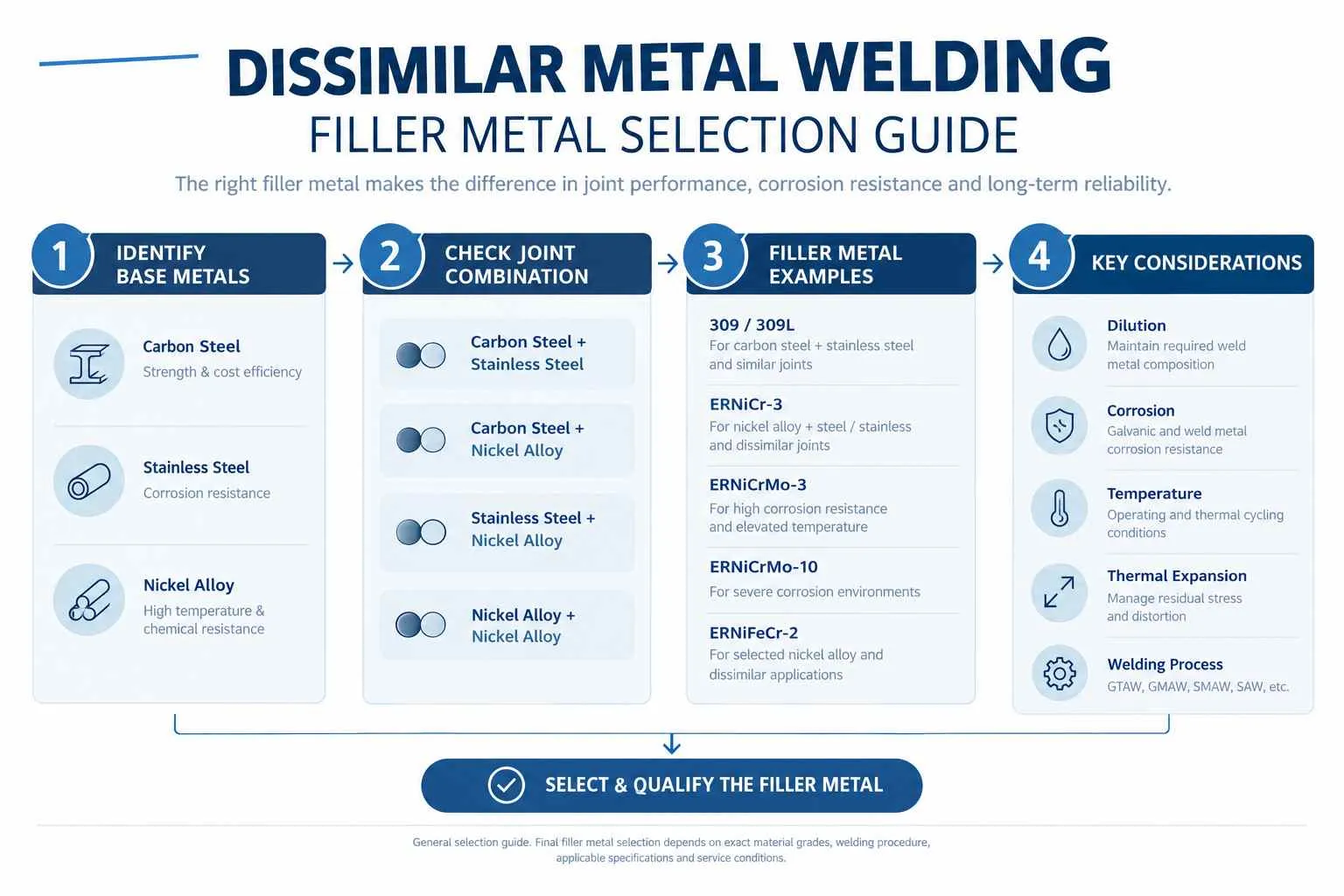
Here’s a critical fact: There is no dedicated “Inconel 713C filler wire” designated under AWS standards. Because Inconel 713C is primarily a cast alloy, it is typically welded using alternative filler metals designed to mitigate cracking while maintaining service performance.
Based on industry practice and metallurgical research, here are the proven options for welding Inconel 713C:
| Filler Wire | AWS Classification | Best For | Key Advantage |
| Hastelloy W | — | General repair welding | Good crack resistance for 713C |
| Inconel 718 | AWS A5.14 ERNiFeCr-2 | High-strength joints | Achieved 1070 MPa tensile strength in EBW studies |
| Inconel 92 | — | Casting repair | Designed for similar Ni-Cr superalloys |
| Inconel 625 | AWS A5.14 ERNiCrMo-3 | Non-structural applications | Readily available, good general performance |
A 2023 study published in the Journal of Manufacturing Processes demonstrated that using Inconel 718 filler wire with electron beam welding (EBW) technology can produce crack-free Inconel 713C joints. The results were remarkable:
The research concluded that controlling chemical composition and heat inputwhile using Inconel 718 as the filleris a viable approach to modifying and strengthening Inconel 713C welded joints.
For joining Inconel 713C to dissimilar materials such as steel, Rotary Friction Welding has shown excellent results. This solid-state process avoids many of the cracking issues associated with fusion welding and can effectively join 713C to steel components.
Successfully welding Inconel 713C requires meticulous attention to every aspect of the welding process. Here are the best practices from industry experts:
Contamination is one of the primary causes of cracking in nickel alloy welding. Keep your work area clean and ensure the base material is free of oils, grease, paints, and surface oxides. Clean surfaces significantly reduce the risk of cracking in nickel alloy welding.
Proper heat management helps avoid hot cracking and maintains weld integrity. Use lower heat input when possible and avoid excessive interpass temperatures. Nickel alloys, especially Inconel 713C, are sensitive to heat input.
Choosing a filler metal that matches or is compatible with the base alloy enhances weld performance and minimizes cracking. For Inconel 713C, Hastelloy W, Inconel 718, or Inconel 92are typically recommended.
Controlling residual stresses through proper preheat and post-weld cooling steps significantly improves weld quality. These steps help manage thermal gradients and reduce crack formation.
Electron beam welding, especially when combined with compatible filler wires like Inconel 718, has been shown to produce crack-free Inconel 713C joints. EBW offers high energy density and can be performed in vacuum environments, reducing contamination risks.
Aging treatments can help optimize the γ′ precipitation structure in the weld zone. However, caution is required—improper PWHT can induce strain-aging cracking. Vacuum heat treatment has been shown to increase hardness by approximately 19% compared to cast conditions.
The need for Inconel 713C welding arises in several demanding industries:
When welding is required for Inconel 713C, it is primarily used for repairing minor surface defects rather than for structural connections. Plasma arc cladding has shown better results for repairs compared to laser methods.
Inconel 713C and related filler metals are governed by several industry standards:
At Ronsco, we understand the complexities of welding high-performance alloys like Inconel 713C. That’s why we offer:
Whether you need Inconel 718, Hastelloy W, or custom filler wire, Ronsco has you covered.
👉 Email us: support@ronsteel.com
Ronsco is a trusted global supplier of nickel alloy and stainless steel welding wires, including Inconel, Hastelloy, and Monel series. Our products are manufactured to meet industry standards and are widely used in demanding applications such as aerospace, oil & gas, chemical processing, and power generation. Explore our resource center for the latest industry insights, product knowledge, and technical references.
Contact us for a quote or technical assistance.


 English
 Español
 русский язык
 اللغة العربية