

In nickel alloy welding, choosing the wrong filler metal can lead to premature weld failure, unexpected equipment shutdowns, and even serious safety risks. When working with AWS ERNiCrMo-3 (Inconel 625 filler metal) and ERNiCr-3 (Inconel 82 filler metal), two of the most widely used nickel-based wires, the selection directly impacts weld integrity, service life, and project cost.
This article provides a detailed ERNiCrMo-3 vs ERNiCr-3 comparison, including chemistry, mechanical properties, corrosion resistance, applications, and selection guidance to help engineers make the right decision.
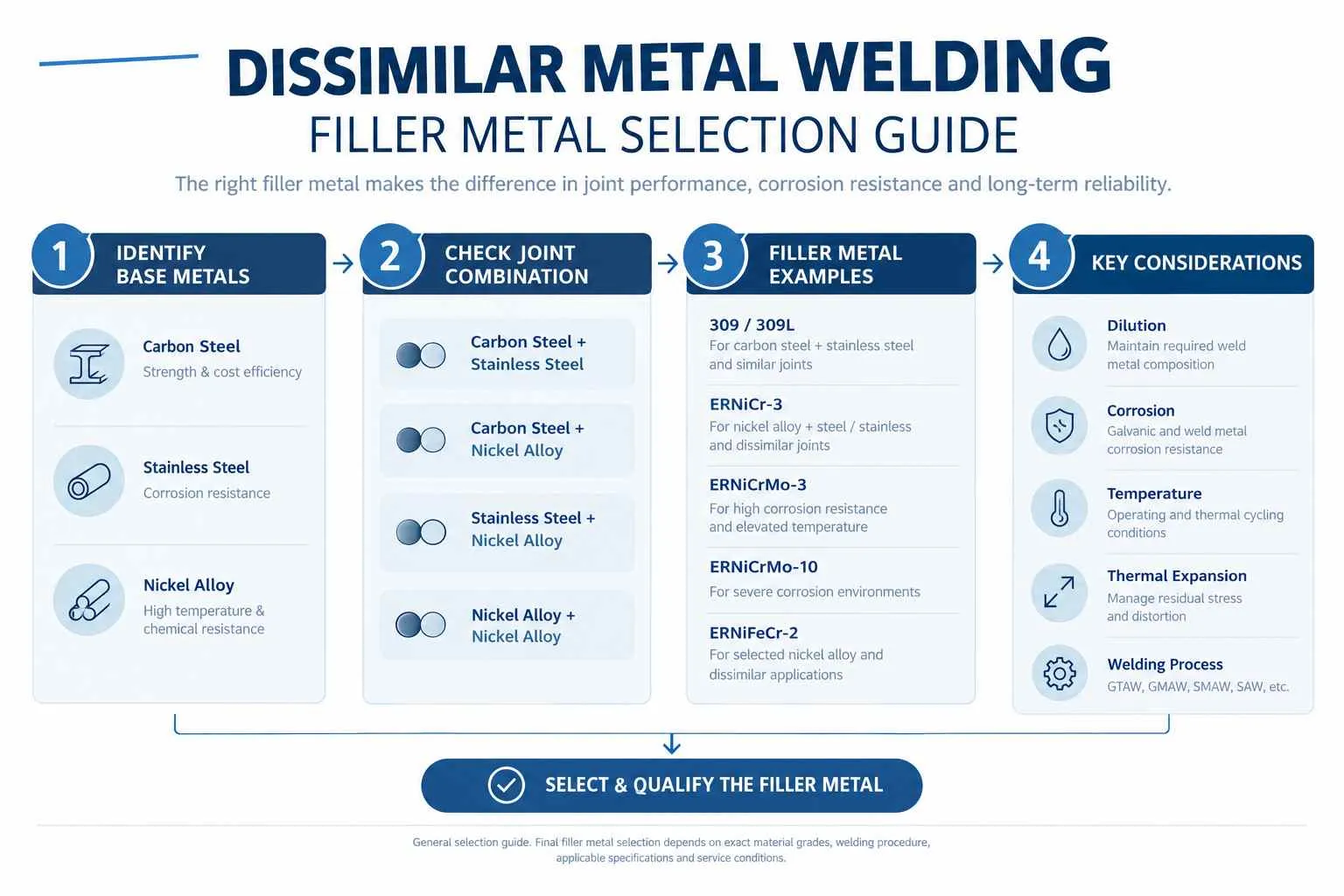
ERNiCrMo-3 and ERNiCr-3 are nickel-based filler metals under AWS A5.14, widely used in TIG, MIG, SAW, and plasma arc welding. Although both belong to the nickel alloy family and share a similar base composition, the remaining differences define two completely different performance profiles.
ERNiCrMo-3 is a Ni-Cr-Mo-Nb system, characterized by high molybdenum (Mo) and niobium (Nb) content. It is designed for extreme corrosion resistance and high-strength applications, typically matching Inconel 625 base materials.
ERNiCr-3 is a Ni-Cr-Fe system with higher manganese content and no molybdenum. It is primarily used for Inconel 600/601-type materials and is known for its excellent weldability and broad compatibility in dissimilar metal welding.
| Element | ERNiCrMo-3 | ERNiCr-3 | Key Difference |
| Nickel (Ni) | 58.0–68.9% | 67.0–77.5% | ERNiCr-3 has higher Ni content |
| Chromium (Cr) | 20.0–23.0% | 18.0–22.0% | Both provide oxidation resistance |
| Molybdenum (Mo) | 8.0–10.0% | 0% | ⚡ Critical difference |
| Niobium (Nb) | 3.15–4.15% | 2.0–3.0% | Stronger solid-solution strengthening in ERNiCrMo-3 |
| Manganese (Mn) | ≤0.5% | 2.5–3.5% | ERNiCr-3 improves crack resistance |
| Iron (Fe) | ≤5.0% | ≤3.0% | Controlled in both |
| Carbon (C) | ≤0.010% | ≤0.10% | ERNiCrMo-3 has ultra-low carbon |
| Property | ERNiCrMo-3 | ERNiCr-3 |
|---|---|---|
| Tensile Strength | ~870 MPa | ~630 MPa |
| Elongation | 34% | 34% |
| Elastic Modulus | 200 GPa | 190 GPa |
| Thermal Expansion | 12 μm/m-K | 13 μm/m-K |
| Solidus Temperature | ~1430°C | ~1330°C |
| Liquidus Temperature | ~1480°C | ~1380°C |
| Density | 8.6 g/cm³ | 8.4 g/cm³ |
ERNiCrMo-3 clearly offers significantly higher strength, about 40% higher tensile strength than ERNiCr-3. This makes it ideal for high-pressure, high-load, and severe thermal cycling environments.
ERNiCr-3, while lower in strength, maintains excellent ductility and weldability. In some dissimilar welding cases, it can even outperform higher-strength alloys due to better stress accommodation and crack resistance.
| Corrosion Type | ERNiCrMo-3 | ERNiCr-3 |
| General corrosion (oxidizing media) | Excellent | Good |
| General corrosion (reducing media) | Excellent | Moderate |
| Pitting & crevice corrosion | Outstanding | Moderate |
| Stress corrosion cracking (chlorides) | Outstanding | Good |
| High-temperature oxidation | Excellent | Excellent |
| Intergranular corrosion | Excellent (low C design) | Good (Nb stabilized) |
The superior corrosion resistance of ERNiCrMo-3 comes mainly from its 8–10% molybdenum content. Mo forms a stable passive film that greatly improves resistance to chloride-induced pitting and crevice corrosion.
It is widely used in marine engineering, seawater systems, chemical processing, flue gas desulfurization, and nuclear applications.
ERNiCr-3 relies mainly on chromium oxide (Cr₂O₃) for protection and performs reliably in high-temperature oxidizing environments, but is less resistant in aggressive chloride media.
ERNiCr-3 offers excellent weldability thanks to its higher manganese content. Mn acts as a strong deoxidizer and helps reduce hot cracking sensitivity, making it particularly suitable for highly restrained joints and dissimilar metal welding.
ERNiCrMo-3, with its ultra-low carbon design, provides excellent resistance to intergranular corrosion during long-term service. However, both alloys require controlled heat input and interpass temperatures below 150°C due to Nb segregation and carbide formation tendencies.
Match filler metal to base material whenever possible:
ERNiCrMo-3 and ERNiCr-3 are not competing substitutes but two specialized solutions designed for different engineering needs. In real engineering practice, the correct choice depends on understanding the service environment, base material compatibility, and performance requirements.
What is the main difference between ERNiCrMo-3 and ERNiCr-3?
The main difference is molybdenum content. ERNiCrMo-3 contains Mo, providing superior corrosion resistance.
Which is better for seawater corrosion?
ERNiCrMo-3 is significantly better due to its high molybdenum content.
Can ERNiCr-3 replace ERNiCrMo-3?
Only in mild environments. It cannot replace ERNiCrMo-3 in chloride-rich or high-corrosion conditions.
What is ERNiCrMo-3 used for?
It is used in offshore, chemical processing, nuclear, and high-corrosion environments.
Which is more cost-effective?
ERNiCr-3 is more economical, while ERNiCrMo-3 offers longer service life.
Ronsco supplies high-quality ERNiCrMo-3 and ERNiCr-3 welding wire for offshore engineering, chemical processing, marine systems, power generation, pressure vessels, and high-corrosion industrial applications.
Available Forms:
Supported Standards:
📧 Send inquiry to: support@ronsteel.com
Ronsco is a trusted global supplier of nickel alloy and stainless steel welding wires, including Inconel, Hastelloy, and Monel series. Our products are manufactured to meet industry standards and are widely used in demanding applications such as aerospace, oil & gas, chemical processing, and power generation. Explore our resource center for the latest industry insights, product knowledge, and technical references.
Contact us for a quote or technical assistance.


 English
 Español
 русский язык
 اللغة العربية