

In aerospace engines, gas turbines, rocket propulsion systems, and high-temperature industrial equipment, nickel-based superalloys are widely recognized for their exceptional high-temperature strength, oxidation resistance, and creep resistance.
Among the many nickel superalloys available today, Inconel 713C and Inconel 718 are two of the most widely used and representative grades.
However, engineers and purchasing specialists often face an important question: Both alloys seem similar at first glance, so what are the real differences between Inconel 713C and Inconel 718? When should you choose 713C, and when is 718 the better option?
As a professional supplier of nickel alloys and welding consumables, Ronsco provides this Inconel 713C vs Inconel 718 guide to help you understand the key differences between these two superalloys.
| Property | Inconel 713C | Inconel 718 |
|---|---|---|
| Alloy Type | Cast Superalloy | Wrought Superalloy |
| Manufacturing Method | Investment Casting | Forging / Rolling / Extrusion |
| Nickel Content | ~70–75% | ~50–55% |
| Iron Content | ≤2.0% | ~18–20% |
| Main Strengthening Phase | γ' (Ni₃(Al,Ti)) | γ'' (Ni₃Nb) + γ' |
| Maximum Service Temperature | ~980°C (1800°F) | ~650–700°C (1200–1300°F) |
| Weldability | Limited | Excellent |
| Typical Applications | Turbine Blades, Vanes, Turbocharger Wheels | Turbine Disks, Casings, Fasteners, Welded Structures |
| Machinability | Difficult | Moderate |
| Typical Product Form | Precision Castings | Bar, Plate, Forgings, Rings |
Inconel713C is a precipitation-strengthened nickel-based cast superalloy specifically designed for high-temperature investment casting applications. It contains relatively high levels of aluminum and titanium, which form a large volume fraction of γ' precipitates (Ni₃(Al,Ti)). These strengthening phases provide excellent creep resistance and oxidation resistance at elevated temperatures.
Because of its high aluminum and titanium content, Inconel 713C has poor hot workability and limited forgeability. As a result, components are typically produced through precision investment casting rather than forging.
This characteristic actually becomes an advantage for manufacturing:
In many gas turbine applications, Inconel 713C remains a highly cost-effective solution for components operating close to 980°C.
Inconel 718 is a precipitation-hardened nickel-iron-chromium superalloy known for its excellent combination of:
Unlike 713C, the primary strengthening mechanism of 718 comes from the γ'' phase (Ni₃Nb), formed by niobium additions. This strengthening system allows Inconel 718 to maintain high mechanical strength while still retaining good formability and weldability.
As a result, 718 can be manufactured into forgings, rolled plates, bars, rings, tubes and even welded assemblies. Today, Inconel 718 is one of the most widely used nickel superalloys in aerospace and energy industries.
The most fundamental difference lies in the manufacturing route.
Inconel 713C
Designed primarily for:
Inconel 718
Designed for:
If your component requires:
Inconel 718 is generally the preferred choice.
If your component requires:
Inconel 713C becomes more suitable.
Temperature capability is often the deciding factor.
When to Choose Inconel 713C
Inconel 713C performs exceptionally well above 700°C and can operate continuously near 980°C.
Typical applications include:
Its excellent creep resistance at elevated temperatures makes it highly valuable in turbine hot sections.
When to Choose Inconel 718
Inconel 718 is generally preferred below 700°C.
It offers:
718 is commonly used for:
Can Inconel 713C Be Welded?
Technically yes, but with significant limitations.
Due to its high aluminum and titanium content, Inconel 713C is highly susceptible to:
Therefore, 713C is generally not recommended for welded structural applications.
Welding is typically limited to:
Recommended Welding Precautions for 713C
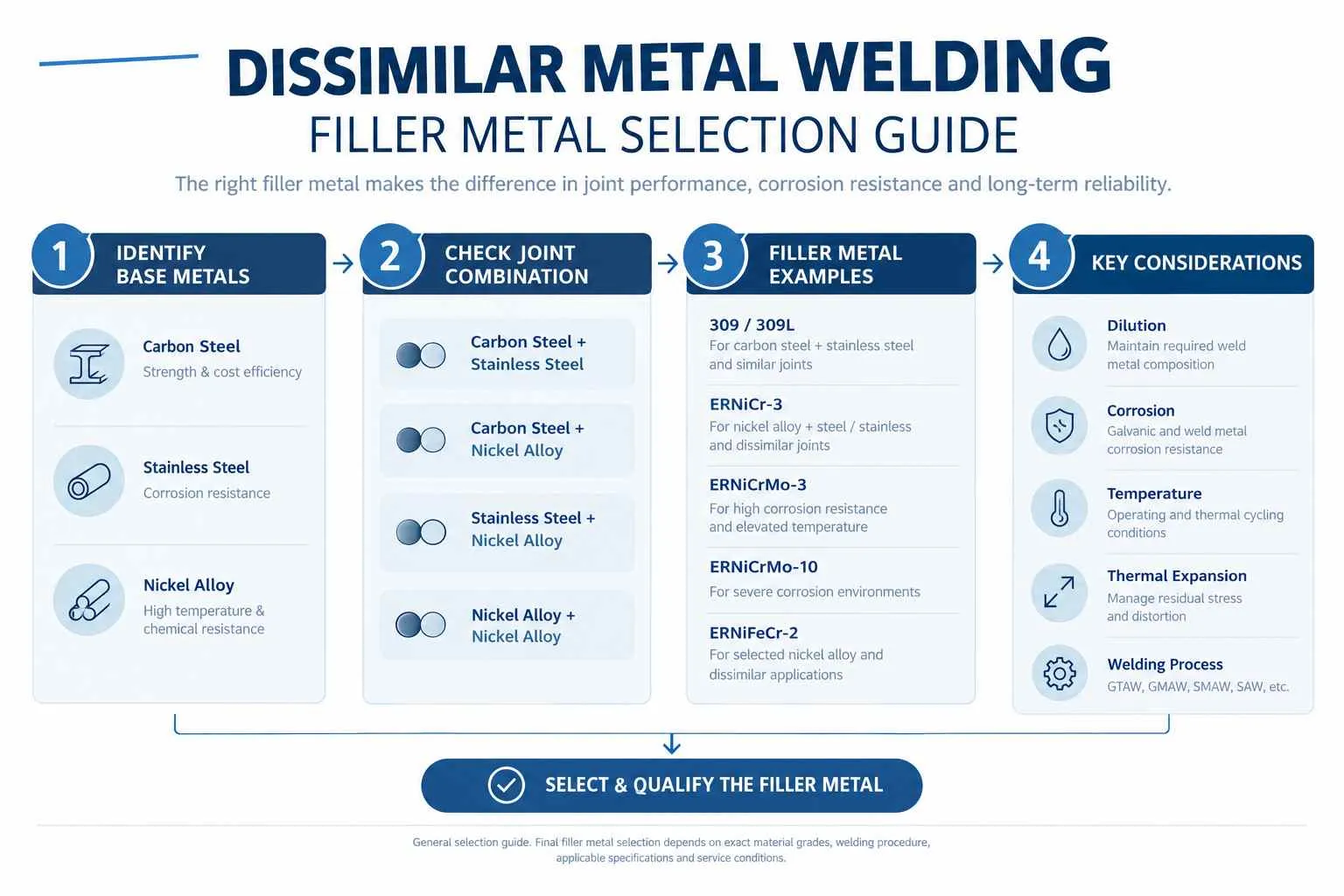
Recommended Filler Metals
Typical filler metals include:
The most commonly recommended filler metal is:
ERNiFeCr-2 is specifically designed to match the chemistry and mechanical properties of Inconel 718.
Key advantages include:
Alternative filler metals:
Common welding processes:
In most cases, preheating is not required for Inconel 718.
| Alloy | Machining Behavior | Recommended Practice |
|---|---|---|
| Inconel 713C | High hardness, moderate work hardening | Carbide tools, low cutting speed, adequate coolant |
| Inconel 718 | Severe work hardening tendency | Low cutting speed, high feed rate, rigid tooling, high-pressure coolant |
Both alloys are considered difficult-to-machine materials compared with stainless steels. However, Inconel 718 is generally easier to machine than 713C.
| Alloy | Solution Treatment | Aging Treatment | Purpose |
|---|---|---|---|
| Inconel 713C | ~1150°C × 2–6h | 900–950°C × 12–24h | γ' precipitation strengthening |
| Inconel 718 | 980–1200°C × 1h | Dual aging: 720°C + 620°C | γ'' + γ' strengthening |
The long aging cycle of 713C is intended to optimize creep resistance at elevated temperatures.
The dual-aging treatment of 718 is designed to maximize yield strength and fatigue performance.
Ronsco is a professional supplier specializing in nickel-based alloys and special alloy welding materials. We provide:
✅ Inconel 713C precision casting base materials and related technical process support
✅ Inconel 718 forgings, bars, plates, and rings
✅ Full range of nickel alloy welding wires, including ERNiFeCr-2 (Inconel 718), ERNiCr-3, and ERNiCrMo-3 (Inconel 625)
✅ Free technical consultation and material selection support
If you have any questions regarding nickel alloy material selection, please feel free to contact our technical team. You can also get a free and quick quote for our products by providing your required specification, diameter, quantity or any other details.
📞 Whatsapp: +8617773160488
📧 Email: support@ronsteel.com
🌐 Website: https://www.ronscowire.com/
Ronsco is a trusted global supplier of nickel alloy and stainless steel welding wires, including Inconel, Hastelloy, and Monel series. Our products are manufactured to meet industry standards and are widely used in demanding applications such as aerospace, oil & gas, chemical processing, and power generation. Explore our resource center for the latest industry insights, product knowledge, and technical references.
Contact us for a quote or technical assistance.


 English
 Español
 русский язык
 اللغة العربية