

In stainless steel welding, ER308L and ER316L are two of the most commonly used filler metals. Both use a low-carbon design (carbon content ≤0.03%) to reduce the risk of intergranular corrosion, but they differ significantly in alloy composition, corrosion resistance, and application. Choosing the wrong welding wire can affect weld quality and may significantly shorten the service life of the weld in corrosive environments.
This article provides a systematic comparison of ER308L and ER316L across five key aspects: chemical composition, mechanical properties, corrosion resistance, applications, and cost. It also answers frequently asked questions about filler metal selection to help you make the right choice for your specific project.
| Comparison | ER308L | ER316L |
|---|---|---|
| AWS Classification | A5.9 ER308L | A5.9 ER316L |
| Matching Base Metal | 304 / 304L | 316 / 316L |
| Key Alloying Elements | Cr + Ni | Cr + Ni +Mo (Molybdenum) |
| Corrosion Resistance | Good | Excellent |
| Resistance to Chloride Pitting | Moderate | High |
| Crack Resistance | High | High |
| Cost Level | Low–Medium | High |
| Typical Industries | Food processing, architectural applications | Marine engineering, chemical processing, pharmaceutical |
The fundamental difference between ER308L and ER316L is the presence or absence of molybdenum, which is the main reason for their different corrosion resistance.
ER308L typically contains approximately 19.5–22.0% Cr, 9.0–11.0% Ni, and ≤0.03% C. Its composition is designed to closely match 304 and 304L stainless steel.
ER316L typically contains approximately 2.0–3.0% Mo, 18.0–20.0% Cr, and 11.0–14.0% Ni. The addition of molybdenum significantly improves resistance to pitting and crevice corrosion, particularly in chloride-containing environments.
Both ER308L and ER316L have a carbon content of ≤0.03%. The “L” suffix indicates a low-carbon grade. Lower carbon content reduces chromium carbide precipitation during welding, helping minimize sensitization and the associated risk of intergranular corrosion.
| Property | ER308L | ER316L |
|---|---|---|
| Yield Strength | ~365 MPa | ~385 MPa |
| Tensile Strength | ~580 MPa | ~590 MPa |
| Elongation | ~38% | ~36% |
According to typical data from ESAB, ER316L has slightly higher yield and tensile strength than ER308L. However, this difference is generally not the primary consideration when selecting between the two welding wires.
In actual engineering applications, the strength difference between the two is usually not the key selection factor. For most stainless steel welding applications, both wires can provide sufficient mechanical performance. Corrosion resistance is the more decisive variable.
This is the most fundamental difference between ER308L and ER316L.
ER316L contains molybdenum, which significantly improves resistance to pitting corrosion. One comparative study found that ER316L welded samples had the lowest corrosion weight loss, at 4.39%, among the tested filler metals, showing the best performance in that specific corrosion test (Vardhan et al., 2025).
Another study focusing on dry storage canister applications further revealed the microstructural mechanism. In the specific welded specimens examined in that study, the δ-ferrite volume fraction in the ER316L weld was approximately 9.5% and appeared as discontinuous isolated regions, while the ER308L weld contained approximately 21.3% δ-ferrite in a continuous network structure (Kim et al., 2026).
This continuous ferrite network can act as an active pathway in chloride-containing environments, accelerating the propagation of stress corrosion cracking.
In simple terms: ER308L is suitable for general environments, while ER316L is generally more suitable for applications requiring higher corrosion resistance.
| Application | ER308L | ER316L |
|---|---|---|
| Food and dairy processing equipment | Recommended | Can be used |
| Water storage tanks and piping systems | Recommended | Can be used |
| Architectural and decorative stainless steel structures | Recommended | Usually unnecessary |
| General industrial machinery | Recommended | Usually unnecessary |
| Marine platforms and ship equipment | ⚠️ Not recommended | Recommended |
| Chemical and petrochemical equipment | ⚠️ Depends on service medium | Recommended |
| Pharmaceutical and medical equipment | Can be used | Recommended |
| Piping systems carrying chloride-containing media | ⚠️ Not the first choice | Recommended |
| 304/304L base metal welding | Default choice | Can be used but usually unnecessary |
| 316/316L base metal welding | Can be used for non-critical applications | Default choice |
A practical rule is:
ER308L can technically be used instead of ER316L for some 316 base-metal applications where corrosion resistance is not critical, but its corrosion resistance will generally be lower.
For marine and chemical applications, ER308L is generally not recommended when the service environment demands the corrosion resistance associated with 316/316L.
ER316L generally has a higher procurement cost than ER308L because of its molybdenum content. Other factors, including certification requirements, inventory, and purchasing conditions, can also affect the final price.
| Price Factor | Impact |
|---|---|
| Alloy composition | Mo content makes ER316L generally more expensive |
| Wire diameter | Different diameters may have different prices |
| Certification | Additional certifications may increase cost |
| Brand and origin | Different suppliers and origins have different pricing |
| Purchase volume | Larger quantities may receive better pricing |
| Lead time and freight | Logistics conditions affect total procurement cost |
Therefore, welding wire selection should not be based only on the price per kilogram. Weld service life, maintenance costs, and potential downtime should also be considered.
When the required performance can be met, ER308L is the more cost-effective choice. In corrosive environments such as marine, chemical, and pharmaceutical applications, the additional material cost of ER316L may be offset by lower corrosion risk and reduced maintenance requirements.
For a real-time quotation, provide the required wire diameter, packaging, certification requirements, and purchase quantity.
📧 Email: support@ronsteel.com
For environments involving chloride, seawater, acidic media, or coastal exposure, ER316L should generally be considered first.
For indoor applications or freshwater environments, ER308L is generally sufficient when the base metal and project requirements are compatible.
If the application has relatively mild service conditions and corrosion resistance requirements can be met with ER308L, its lower material cost can make it a more economical option.
ER308L is mainly used for welding 304 and 304L stainless steel and is also suitable for similar 300-series stainless steels, including 301, 302, 305, 308, 321, and 347 in appropriate applications.
Typical applications include food processing equipment, brewery piping, pharmaceutical equipment, water tanks, architectural structures, and general stainless steel manufacturing.
Its low carbon content helps reduce the risk of sensitization and intergranular corrosion after welding.
Yes, ER308L can technically be used to weld 316 stainless steel under certain conditions. However, because ER308L does not contain molybdenum, the resulting weld metal generally has lower corrosion resistance than a weld made with ER316L.
If 316 stainless steel is selected because chloride or chemical corrosion resistance is important, ER316L is generally preferred. If corrosion resistance is not a critical requirement, ER308L may be technically acceptable in some applications.
Typical weld-metal data shows that ER316L can have slightly higher yield and tensile strength than ER308L. However, this difference is usually not the main factor in selecting between the two.
The base-metal match and service environment are generally more important considerations.
For applications requiring higher resistance to chloride-induced pitting and crevice corrosion, ER316L is generally preferred.
The main reason is its approximately 2.0–3.0% molybdenum content, which improves localized corrosion resistance.
The final selection should still consider the base metal, service medium, temperature, and specific project requirements.
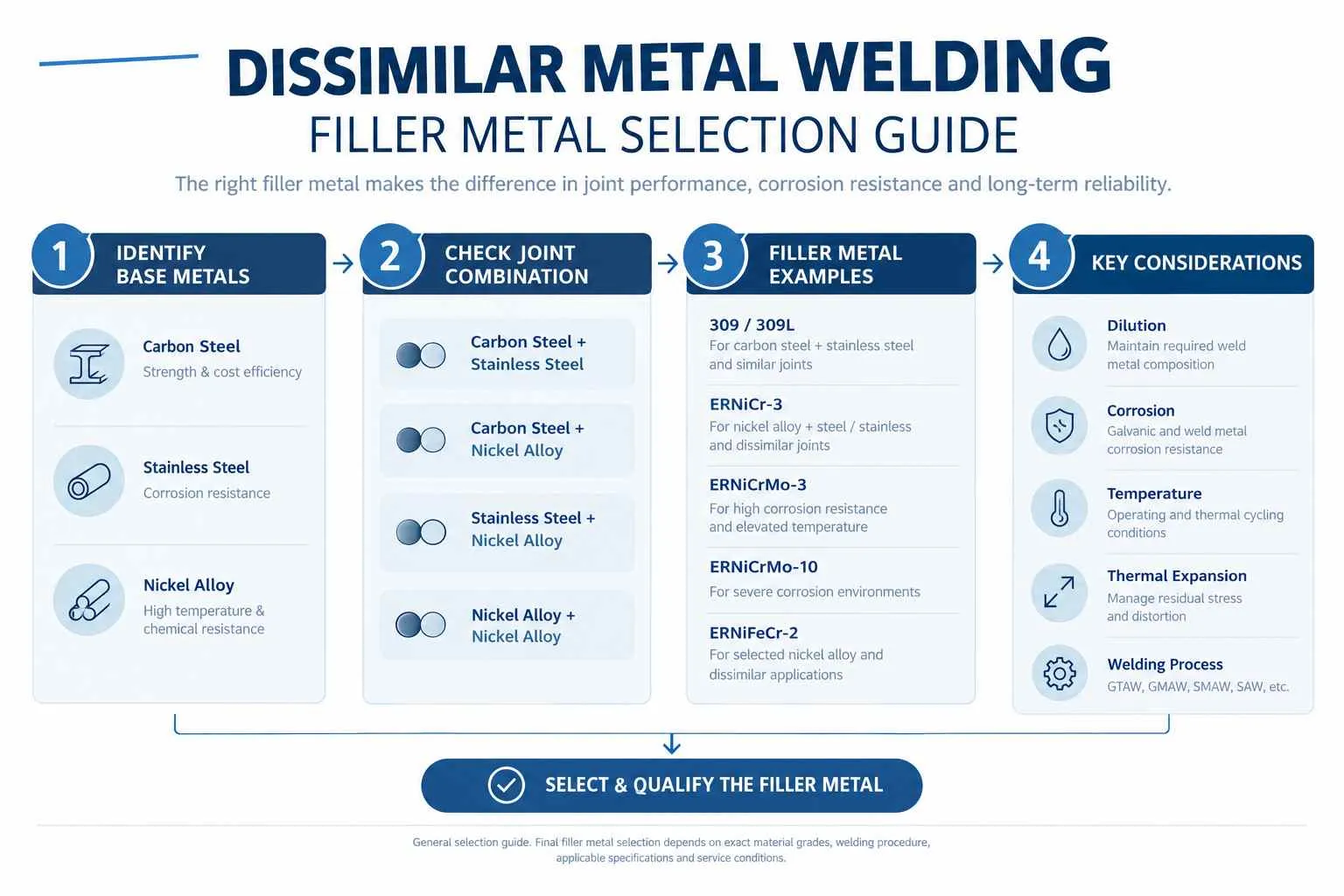
ER308L can technically be used in some stainless-steel-to-carbon-steel welding situations, but it is generally not the preferred filler metal.
Because of dilution from the carbon steel, the weld may develop martensitic structures that can be harder and more brittle. ER309L is commonly used for stainless steel to mild steel or carbon steel joints.
If ER308L is the only available option, it may be considered for limited or non-critical situations, but it should generally be avoided for load-bearing or critical structures.
ER308L is an economical general-purpose stainless steel filler metal suitable for 304 base metal and general service environments. ER316L, with its molybdenum-enhanced corrosion resistance, is commonly selected for demanding environments such as marine, chemical, and pharmaceutical applications.
The core principle when choosing between them is simple: match the welding wire to the base metal and service environment rather than looking only at the price.
[1] Vardhan, A., Mishra, A., & Kumar, G. (2025). Investigation of the Effects of Filler Wires on the Microstructural and Mechanical Properties of GTAW-Welded IS2062E350C Pressure Vessel Steel. Journal of the Chinese Society of Mechanical Engineers, Series C, 46(5), 517–526.
[2] Kim, S., Kim, G., & Song, S.-W. (2026). Selective corrosion of δ-ferrite in austenitic stainless steel welds under wet–dry cycling: Influence of surface temperature for dry storage canister applications. Nuclear Engineering and Technology, 58(5), 104141. DOI: 10.1016/j.net.2026.104141.
Ronsco is a trusted global supplier of nickel alloy and stainless steel welding wires, including Inconel, Hastelloy, and Monel series. Our products are manufactured to meet industry standards and are widely used in demanding applications such as aerospace, oil & gas, chemical processing, and power generation. Explore our resource center for the latest industry insights, product knowledge, and technical references.
Contact us for a quote or technical assistance.


 English
 Español
 русский язык
 اللغة العربية