

Dissimilar metal welding is the process of joining two different metals or alloys with different chemical compositions, metallurgical characteristics, or physical properties. It is widely used in power generation, chemical processing, petrochemical, oil and gas, marine, and other industries where different materials are selected for specific performance requirements.
The main challenge is not simply joining two different metals, but producing a weld that remains mechanically sound, metallurgically stable, and sufficiently resistant to corrosion and service conditions.
The key to successful dissimilar metal welding is proper filler metal selection, controlled dilution, and a qualified welding procedure.
This guide explains which metals can be welded together, the main challenges, how to select filler metals, and where nickel alloy filler metals are commonly considered.
Dissimilar metal welding refers to joining two different base metals or alloys by welding. The materials may differ significantly in chemical composition, melting range, thermal conductivity, coefficient of thermal expansion, or metallurgical structure.
Common combinations include:
Dissimilar joints are often used because each material provides a specific advantage. Carbon steel, for example, offers strength and cost efficiency, while stainless steel or nickel alloys provide improved corrosion or high-temperature resistance.
Yes, many different metals can be welded together, but not every combination is suitable for conventional fusion welding.
The feasibility of a dissimilar metal joint depends on:
Carbon steel and austenitic stainless steel are commonly joined using suitable welding procedures and filler metals. Nickel-based filler metals are also used for selected joints involving nickel alloys, stainless steels, carbon steels, and low-alloy steels.
Therefore, the important question is not simply whether two metals are different, but whether a suitable filler metal and qualified welding procedure can produce the required joint properties.
Carbon steel-to-stainless steel is one of the most common dissimilar metal joints.
Filler metals such as 309/309L stainless steel may be considered for certain combinations because they can accommodate dilution from the carbon steel side while providing appropriate weld metal properties.
For more demanding service conditions, a nickel-based filler may be considered depending on the exact materials, corrosion requirements, and welding procedure.
Nickel alloy filler metals can be used for selected carbon steel-to-nickel alloy joints where corrosion resistance, elevated-temperature performance, or metallurgical compatibility is important.
ERNiCr-3 is one nickel-based filler metal commonly considered for certain dissimilar combinations.
Stainless steel-to-nickel alloy joints are frequently found in chemical processing, petrochemical, power generation, and corrosion-resistant equipment.
Nickel-based filler metals may be preferred when the joint requires high corrosion resistance or when their composition provides better compatibility with the nickel alloy side.
Different nickel alloys should not automatically be treated as equivalent simply because they are both nickel-based.
Differences in alloying elements, corrosion resistance, precipitation behavior, and service temperature can affect filler metal selection.
Both base metals contribute material to the weld pool. This is known as dilution.
Excessive dilution can significantly change the final weld metal composition and may affect strength, ductility, corrosion resistance, or cracking resistance.
Different metals expand and contract at different rates during welding and cooling.
A large difference in thermal expansion can generate residual stresses, which may contribute to distortion, cracking, or long-term degradation during thermal cycling.
When two materials have significantly different melting temperatures or ranges, controlling heat input and fusion becomes more difficult.
The welding procedure must provide sufficient fusion without unnecessarily increasing dilution or damaging the lower-melting material.
Certain combinations of alloying elements can produce undesirable microstructures or brittle phases.
For this reason, filler metal selection should consider the final weld metal chemistry rather than simply matching one of the base metals.
Dissimilar metal joints can also present additional corrosion considerations.
Differences in electrochemical behavior may contribute to galvanic corrosion, while differences in weld metal composition can affect localized corrosion resistance.
For corrosion-critical applications, the service environment should be considered during filler metal selection.
There is no single filler metal suitable for all dissimilar metal welding applications. Selection should start with the exact grades of both base metals.
Confirm the exact material designation, such as the ASTM/ASME specification, UNS number, or EN designation.
"Stainless steel" or "nickel alloy" alone is not sufficient for precise filler metal selection.
Evaluate important alloying elements such as Nickel, Chromium, Molybdenum, Iron, Carbon, Copper, Manganese and Silicon.
This helps determine whether the filler metal can accommodate dilution from both sides.
The final weld metal is normally a combination of filler metal and melted base metal.
A suitable filler may therefore need sufficient alloy content to maintain the required weld properties after dilution.
Filler selection should account for:
A filler metal that is weldable may not necessarily provide the required long-term service performance.
Common welding processes include GTAW/TIG, GMAW/MIG, SMAW and SAW.
The filler metal classification, product form, diameter, and deposition characteristics should be compatible with the selected process.
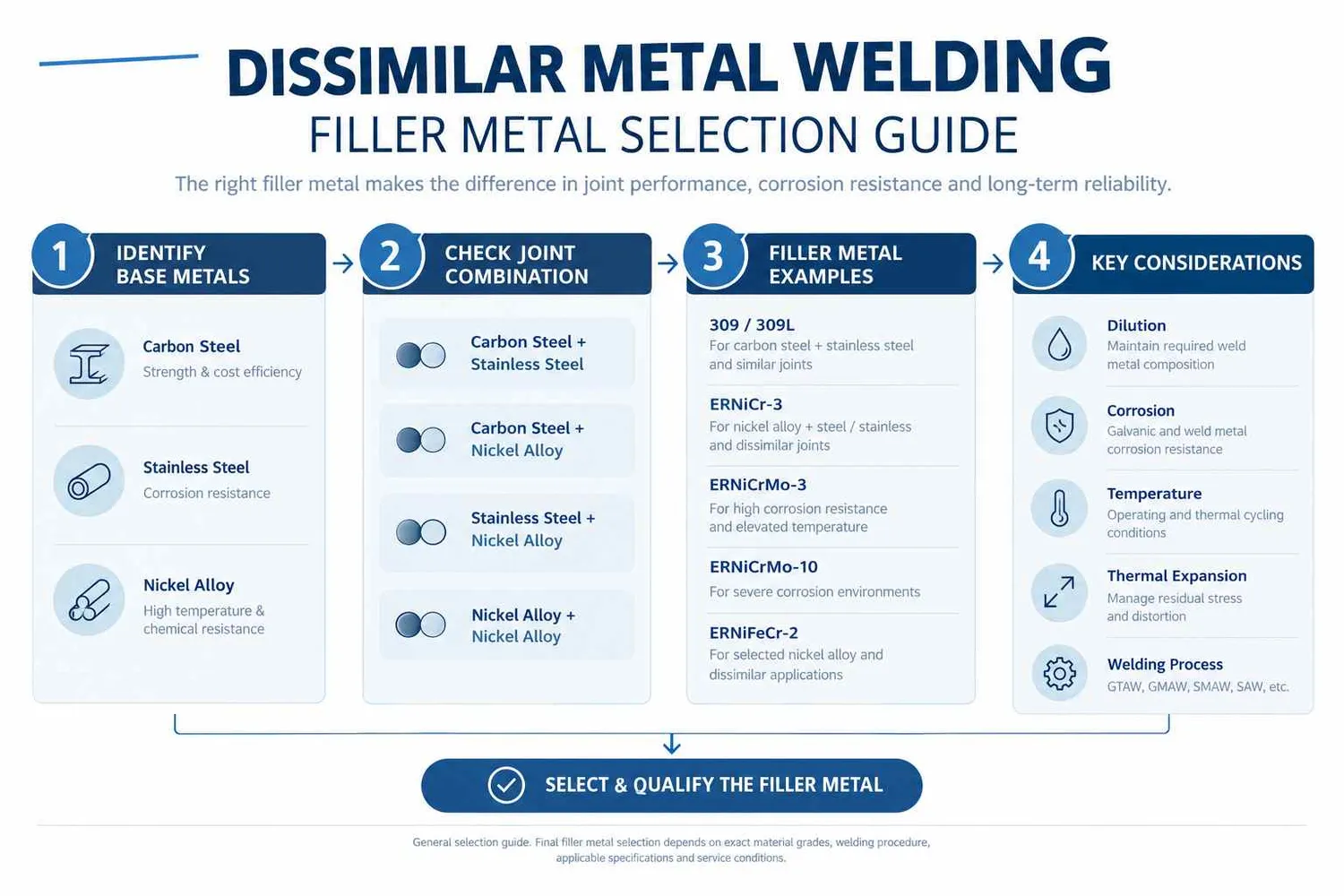
The following chart provides a general filler metal selection reference. The final filler should be verified against the exact material grades, welding procedure, applicable codes, and service conditions.
| Base Metal Combination | Filler Metal Considerations | Main Concerns |
|---|---|---|
| Carbon steel + stainless steel | 309/309L or suitable nickel-based filler | Dilution, cracking, corrosion |
| Carbon steel + nickel alloy | ERNiCr-3 or other suitable nickel-based filler | Dilution, thermal expansion |
| Stainless steel + nickel alloy | Nickel-based or suitable stainless filler | Corrosion, dilution, metallurgical compatibility |
| Austenitic stainless steel + low-alloy steel | 309/309L or nickel-based filler | Thermal stress, dilution |
| Different stainless steel grades | Matching or over-alloyed stainless filler | Corrosion, ferrite, cracking |
| Different nickel alloys | Filler selected according to specific alloy combination | Microstructure, cracking, corrosion |
| Copper + steel | Specialized filler and welding procedure | Thermal conductivity, melting behavior |
This chart is a starting point, not a substitute for a qualified welding procedure. The correct filler metal depends on the complete joint and its intended service.
Nickel-based filler metals are commonly considered for selected dissimilar joints involving nickel alloys, stainless steels, carbon steels, and low-alloy steels. They can be useful when the joint requires good corrosion resistance, elevated-temperature performance, or compatibility with the nickel alloy side.
Common examples include:
| Filler Metal | Typical Application Consideration |
|---|---|
| ERNiCr-3 | Selected nickel alloy-to-steel and stainless steel dissimilar joints |
| ERNiCrMo-3 | Applications requiring higher corrosion resistance and strength |
| ERNiCrMo-10 | Selected joints exposed to severe corrosive environments |
| ERNiFeCr-2 | Selected nickel alloy and dissimilar metal applications |
However, the highest-alloy filler metal is not automatically the best choice. Selection should be based on the exact base metal grades, dilution, welding process, service temperature, corrosion environment, and applicable welding specifications.
Corrosion should be considered from the beginning of dissimilar joint design.
When dissimilar metals are electrically connected in the presence of an electrolyte, differences in electrochemical potential can contribute to galvanic corrosion.
The risk depends on the material combination, electrolyte, temperature, surface area ratio, joint design, and service environment.
The weld metal may have a different composition from either base metal because of filler metal chemistry and dilution.
For corrosion-critical applications, the filler should therefore be selected based on the required corrosion performance rather than simply matching one base metal.
Hot cracking and other forms of cracking can occur when weld metal composition, heat input, restraint, and metallurgical conditions are unfavorable.
Excessive dilution can change weld metal chemistry and reduce the intended performance of the filler metal.
Certain material combinations can promote undesirable phases that reduce ductility or toughness.
Different thermal expansion behavior can create residual stresses and distortion, particularly in highly restrained joints.
Improper filler selection or excessive heat input may reduce corrosion resistance in the weld region.
A reliable dissimilar metal welding procedure normally combines correct material identification, appropriate filler metal selection, controlled welding parameters, and inspection.
Key practices include:
Yes. Many different metals can be joined by welding when their metallurgical compatibility, thermal properties, filler metal, and welding procedure are properly considered. Some combinations, however, are difficult or unsuitable for conventional fusion welding.
There is no universal list of metals that can never be welded. Some combinations are extremely difficult because of large differences in melting temperature, thermal expansion, or metallurgical compatibility. Specialized welding processes or alternative joining methods may be required.
The electrode depends on the base metals and welding process. Stainless steel electrodes, nickel alloy electrodes, and other specialized filler metals may be used. There is no universal electrode for every dissimilar metal joint.
The filler depends on the exact base metal combination and service requirements. 309/309L may be considered for certain stainless steel-to-carbon steel joints, while nickel-based fillers such as ERNiCr-3, ERNiCrMo-3, ERNiCrMo-10, and ERNiFeCr-2 may be suitable for selected nickel alloy and dissimilar metal applications.
Yes. Nickel alloy filler metals are used for selected joints involving nickel alloys, stainless steels, carbon steels, and low-alloy steels. Their high alloy content can provide useful corrosion resistance and metallurgical compatibility, but the specific filler must be matched to the complete joint.
The answer depends on the specific nickel alloy and stainless steel grades. Nickel-chromium or nickel-chromium-molybdenum filler metals may be considered for demanding combinations, with dilution, corrosion requirements, temperature, and applicable specifications taken into account.
It can increase certain corrosion risks, particularly when the joined materials have different electrochemical behavior. Galvanic corrosion, weld metal composition, heat-affected zones, and the service environment should all be considered.
Ronsco is a trusted global supplier of nickel alloy and stainless steel welding wires, including Inconel, Hastelloy, and Monel series. Our products are manufactured to meet industry standards and are widely used in demanding applications such as aerospace, oil & gas, chemical processing, and power generation. Explore our resource center for the latest industry insights, product knowledge, and technical references.
Contact us for a quote or technical assistance.


 English
 Español
 русский язык
 اللغة العربية