

TIG welding, formally known as GTAW (Gas Tungsten Arc Welding), uses a non‑consumable tungsten electrode to create the arc. Unlike MIG, the filler metal is not part of the electrical circuit. The welder holds the torch in one hand to control the arc and manually feeds a filler rod into the weld pool with the other. Pure argon or argon‑rich gas mixtures shield the weld area. TIG gives the welder exceptional control over heat input and weld bead shape, which is why it's often called the “precision process” of welding.
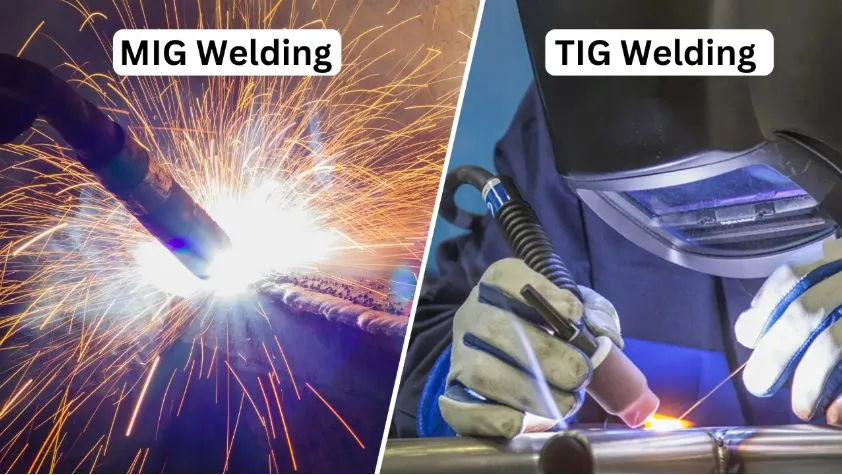
The table below summarises the main differences to help you quickly see which process fits your needs.
| Aspect | MIG Welding | TIG Welding |
|---|---|---|
| Electrode & Filler | Continuous wire electrode; wire acts as both electrode and filler | Non‑consumable tungsten electrode; filler rod added separately |
| Travel Speed | Fast – approx. 500‑600 mm/min (3 mm steel) | Slow – approx. 100‑200 mm/min (3 mm steel) |
| Learning Curve | Easy to learn, beginner‑friendly | Steep curve; requires two‑hand coordination and skill |
| Material Thickness | Best for thicker materials (1 mm and up) | Excellent for thin materials (down to 0.13 mm) |
| Weld Appearance | Strong and reliable, but spatter may require post‑weld cleaning | Clean, aesthetic welds with almost no spatter |
| Equipment Cost | Lower entry cost; affordable maintenance | Higher investment; tungsten and gas costs add up |
| Materials | Carbon steel, stainless steel, aluminium (with special feeder) | Stainless steel, aluminium, titanium, magnesium, copper, dissimilar metals |
| Power Type | Mainly DC | Both DC and AC – AC is essential for aluminium |
| Outdoor Use | Shielding gas easily blown away | Relatively more resistant to draft |
Cost is often the deciding factor. MIG and TIG differ significantly in both equipment and per‑part cost.
💡 Specialty materials, e.g., nickel alloys: When working with nickel‑based alloys, titanium, or superalloys, filler metal selection becomes critical. We offer dedicated MIG/TIG nickel alloy welding wires to ensure corrosion resistance and high‑temperature performance: https://www.ronscowire.com/product.
The boundaries between processes are blurring. Automation and hybrid systems now deliver both quality and productivity.
| Your situation | Recommended process |
|---|---|
| Inexperienced welder, want an easy start | MIG |
| High volume, time‑sensitive, cost‑sensitive | MIG |
| Thick steel plates, structural steel, heavy sections | MIG |
| Need clean, spatter‑free, cosmetic welds | TIG |
| Thin materials, aluminium, titanium, exotic metals | TIG |
| Critical welds requiring X‑ray inspection or sanitary standards | TIG |
| Root pass quality & high‑speed fill required | Hybrid MIG+TIG system |
MIG and TIG serve different purposes. MIG is the productivity champion. It is fast, easy to learn, and cost effective for thick sections and high volume work. TIG is the precision choice. It produces beautiful, clean welds with minimal distortion, making it ideal for thin materials, critical joints, and high value components.
For most fabrication shops, keeping both processes on hand is the best strategy. Use MIG for the bulk of production and TIG for detail work and high appearance welds. With hybrid automated systems on the rise, you no longer have to choose between speed and quality.
Ronsco is a trusted global supplier of nickel alloy and stainless steel welding wires, including Inconel, Hastelloy, and Monel series. Our products are manufactured to meet industry standards and are widely used in demanding applications such as aerospace, oil & gas, chemical processing, and power generation. Explore our resource center for the latest industry insights, product knowledge, and technical references.
Contact us for a quote or technical assistance.


 English
 Español
 русский язык
 اللغة العربية